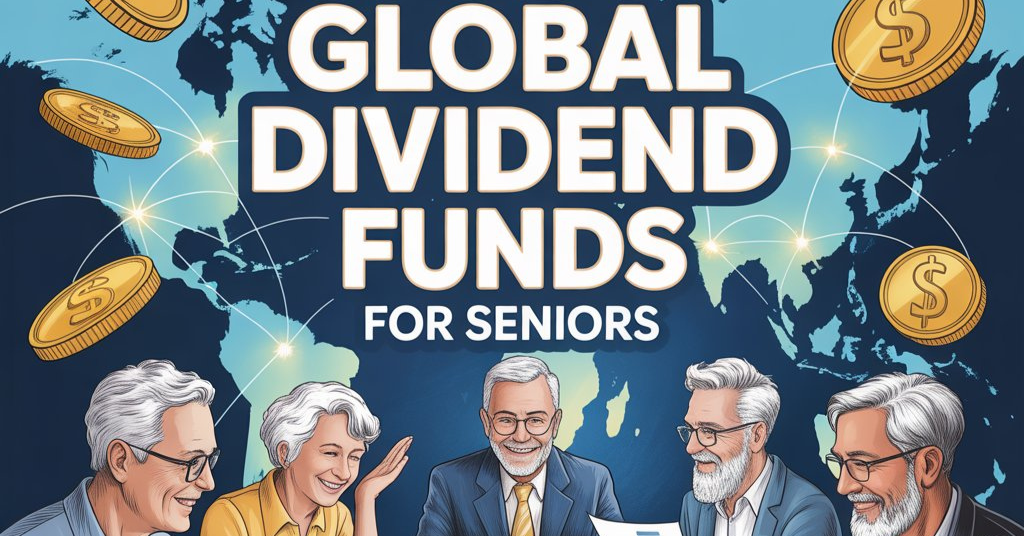
Retirement is a time to enjoy life without worrying about monthly income. For many seniors, dividend funds offer a practical way to generate regular cash flow while keeping investments diversified. Instead of picking individual stocks, dividend exchange-traded funds (ETFs) and mutual funds allow retirees to invest in dozens or even hundreds of companies that regularly pay dividends.
In this detailed guide, we will explore the best global dividend funds for seniors, explain how they work, show dollar-based income examples, and help you understand how to choose the right option for your retirement portfolio.
Why Dividend Funds Are Popular Among Seniors
When you retire, your regular paycheck stops. But your expenses continue — groceries, electricity, healthcare, travel, and daily living costs.
Dividend funds help in three main ways:
- Regular Income – Many funds pay quarterly, and some pay monthly.
- Diversification – Instead of depending on one company, your money spreads across many.
- Potential Growth – Many dividend companies are established global businesses that can grow over time.
For example:
- If a fund pays a 4% annual dividend yield
- And you invest $300,000
- Your estimated annual income = $12,000
- That equals $1,000 per month (approx.)
This predictable income stream is what makes dividend funds attractive to retirees.
Understanding Dividend Yield (Simple Explanation)
Dividend yield is the percentage of income you receive relative to your investment.
Formula:
Annual Dividend Income = Investment × Dividend Yield
Example:
If you invest $100,000 in a fund with a 5% yield:
$100,000 × 5% = $5,000 per year
That equals about $416 per month.
However, seniors should not chase only high yield. A very high yield (like 9–10%) can sometimes signal higher risk.
Best Global Dividend Funds for Seniors
Below are well-known global dividend ETFs that many income-focused investors consider. These funds invest in established companies that regularly pay dividends.
1. Vanguard High Dividend Yield ETF (VYM)
This ETF focuses on U.S. companies that pay above-average dividends.
Why Seniors Like It
- Broad diversification
- Lower expense ratio
- Large, stable companies
- Quarterly dividends
Income Example
If you invest $250,000 and the yield is approximately 3.5%:
$250,000 × 3.5% = $8,750 annually
Monthly equivalent ≈ $729
This may not sound very high, but the stability and diversification make it suitable for conservative retirees.
2. Schwab Asset Management U.S. Dividend Equity ETF (SCHD)
This fund focuses on companies with strong financial health and a consistent dividend history.
Key Features
- Quality screening
- Competitive yield
- Lower cost structure
- Dividend growth focus
Income Example
If yield is 3.8% and you invest $400,000:
$400,000 × 3.8% = $15,200 annually
Monthly income ≈ $1,266
This can cover major household expenses for many seniors.
3. Fidelity Investments High Dividend ETF (FDVV)
This ETF targets higher-yielding companies with strong fundamentals.
Why It May Suit Seniors
- Focus on profitability
- Competitive dividend rate
- Diversified exposure
Example
$200,000 investment at 4% yield:
$200,000 × 4% = $8,000 annually
Monthly ≈ $666
FDVV can complement other dividend funds in a retirement portfolio.
4. SPDR S&P Dividend ETF (SDY)
This fund tracks companies that have consistently increased dividends for many years.
Why It’s Attractive
- Dividend growth focus
- Historically resilient companies
- Long-term stability
Income Example
$350,000 invested at 2.8% yield:
$350,000 × 2.8% = $9,800 annually
Monthly ≈ $816
While yield is slightly lower, dividend growth can help fight inflation over time.
5. Vanguard International High Dividend Yield ETF (VYMI)
For seniors seeking global diversification, this fund invests outside the United States.
Benefits
- Reduces dependence on one country
- Exposure to Europe and Asia
- Higher international yield potential
Example
$150,000 at 4.5% yield:
$150,000 × 4.5% = $6,750 annually
Monthly ≈ $562
Adding global exposure can reduce risk if one region struggles economically.
Sample Retirement Income Portfolio (With Dollar Calculations)
Let’s build a hypothetical retirement portfolio for a senior with $500,000 invested.
| Fund | Allocation | Yield | Annual Income |
| VYM | $150,000 | 3.5% | $5,250 |
| SCHD | $150,000 | 3.8% | $5,700 |
| VYMI | $100,000 | 4.5% | $4,500 |
| FDVV | $50,000 | 4% | $2,000 |
| Bonds/Cash | $50,000 | 2% | $1,000 |
Total Estimated Annual Income
$18,450
Monthly Equivalent
$1,537
This diversified approach reduces risk while generating steady income.
What Seniors Should Consider Before Investing
1. Expense Ratio
If a fund charges 0.50% annually and you invest $300,000:
Annual cost = $1,500
But if another fund charges 0.06%:
Annual cost = $180
Over 10 years, the difference could exceed $13,000. Lower fees matter greatly in retirement.
2. Dividend Stability vs. High Yield
A 7% yield sounds attractive.
But:
$200,000 × 7% = $14,000
If dividends get cut by 40%, income drops to:
$8,400
That sudden drop may affect your retirement lifestyle.
Stable 3–4% yields are often safer for seniors.
3. Inflation Protection
Dividend growth funds can help.
If your dividend increases by 5% annually:
Year 1: $12,000
Year 5 (approx.): $14,600
This protects purchasing power.
Monthly vs Quarterly Dividend Funds
Some retirees prefer monthly payouts because:
- Easier budgeting
- Matches household expenses
- Reduces need to sell units
Quarterly payouts are common in large ETFs.
If you need $3,000 per month and your fund pays quarterly:
You may need a small cash buffer to manage timing.
Risk Factors Seniors Should Understand
Even dividend funds are not risk-free.
Market Risk
If markets fall 20%, your $400,000 portfolio becomes $320,000. Dividends may continue, but account value drops.
Currency Risk (Global Funds)
International funds fluctuate with exchange rates.
Sector Risk
Some high dividend funds concentrate in banks, utilities, or energy.
Diversification across regions and sectors reduces these risks.
How Much Should Seniors Invest in Dividend Funds?
This depends on risk tolerance.
Conservative Example
- 40% Dividend ETFs
- 40% Bonds
- 20% Cash
Moderate Example
- 60% Dividend ETFs
- 30% Bonds
- 10% Cash
If total retirement savings = $800,000
60% dividend allocation = $480,000
At 3.8% average yield:
$480,000 × 3.8% = $18,240 annually
This can cover a significant portion of living expenses.
Dividend Funds vs Individual Stocks
Why many seniors prefer funds:
| Dividend Stocks | Dividend Funds |
| Company-specific risk | Diversified |
| Requires research | Professionally managed |
| Higher volatility | Balanced approach |
| Harder to track | Simple structure |
For retirees, simplicity and stability are valuable.
Reinvestment Strategy for Younger Seniors
If you retire at 60 but don’t need full income yet:
Reinvest dividends for 5 years.
Example:
$300,000 at 4% yield = $12,000 per year
If reinvested and portfolio grows modestly, you could add $60,000+ extra capital over 5 years (depending on market growth).
That increases future income significantly.
When Dividend Funds May Not Be Ideal
- If you need very high immediate income
- If you cannot tolerate market fluctuations
- If you prefer guaranteed fixed returns
In such cases, combining dividend funds with annuities or bonds may be safer.
Also Read: Best Tax Efficient Investments For Retirees
Final Thoughts: Best Global Dividend Funds for Seniors
Global dividend funds can provide:
✔ Regular income
✔ Diversification
✔ Inflation protection
✔ Simplicity
A balanced mix of funds such as those offered by Vanguard, Schwab, Fidelity, and SPDR can create a stable income structure for retirement.
For example:
$600,000 invested at an average 4% yield = $24,000 per year
That equals $2,000 per month
Combined with pensions or social security benefits, this can form a comfortable retirement income plan.
The key for seniors is balance — not chasing the highest yield, but building a diversified portfolio that generates dependable income while protecting capital.
Always review your risk tolerance, health needs, and expected retirement years before investing. Consulting a qualified financial advisor can further personalize your strategy.
With careful planning, global dividend funds can be a powerful tool to enjoy financial peace during retirement.