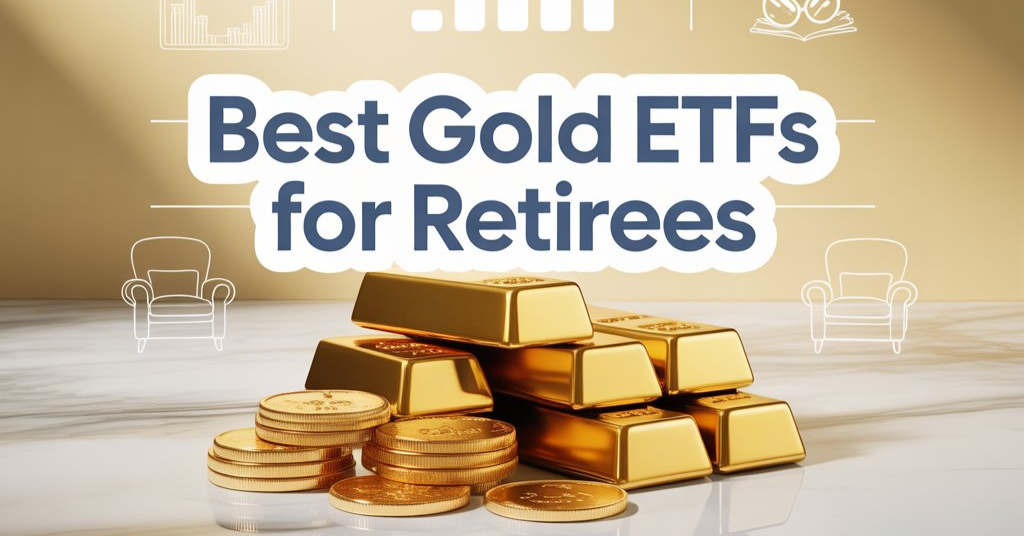
Retirement is a time when protecting wealth becomes more important than chasing high returns. Most retirees look for investments that offer stability, diversification, and protection against inflation. One asset that has stood the test of time is gold.
But instead of buying physical gold bars or coins, many retirees today prefer Gold ETFs (Exchange-Traded Funds). These funds allow you to invest in gold easily through the stock market without worrying about storage or security.
In this detailed guide, we will explore:
- What Gold ETFs are
- Why retirees consider them
- The best gold ETFs for retirees (especially on ASX)
- Real-life dollar examples and calculations
- Risks and smart allocation strategies
Let’s begin.
What Is a Gold ETF?
A Gold ETF is a fund traded on a stock exchange that tracks the price of gold. When you buy one unit of a gold ETF, you are essentially investing in gold without physically holding it.
There are two main types:
- Physical Gold ETFs – These hold actual gold in vaults.
- Gold Mining ETFs – These invest in gold mining companies.
For retirees, physical gold ETFs are usually safer and more stable than mining ETFs.
Why Gold Is Important for Retirees
1. Protection Against Inflation
Inflation reduces purchasing power over time. If inflation is 5% per year, something that costs $10,000 today will cost:
- After 1 year: $10,500
- After 5 years: $12,763
- After 10 years: $16,289
Gold historically tends to perform well during inflationary periods.
2. Portfolio Diversification
A retirement portfolio may include:
- 50% Stocks
- 40% Bonds
- 10% Gold
Gold often moves differently from stocks and bonds. When markets fall, gold sometimes rises, helping reduce overall losses.
3. Crisis Hedge
During financial crises or geopolitical tensions, investors move toward gold as a “safe haven.”
For retirees living on fixed income, this stability matters.
Best Gold ETFs for Retirees (ASX Focus)
Below are some well-known gold ETFs that retirees often consider.
1. Global X Physical Gold (ASX: GOLD)
This ETF tracks the physical price of gold and is one of the largest gold ETFs listed in Australia.
Key Features
- Backed by physical gold
- Strong liquidity
- Management fee around 0.40%
Dollar Example
If you invest $50,000:
Annual fee = 0.40% of $50,000
= 0.004 × 50,000
= $200 per year
If gold grows by 8% in a year:
Gain before fee = $4,000
Net gain after fee = $4,000 – $200
= $3,800
Your investment becomes $53,800
2. Perth Mint Gold (ASX: PMGOLD)
This ETF is backed by gold stored at the Perth Mint and is known for its government backing.
Key Features
- Government guarantee
- Low management fee (~0.15%)
- High safety appeal
Dollar Example
Investment: $50,000
Annual fee: 0.15%
= 0.0015 × 50,000
= $75 per year
If gold grows 8%:
Gain before fee = $4,000
Net gain = $4,000 – $75
= $3,925
Final value = $53,925
Compared to the previous ETF, you save $125 in fees annually.
Over 10 years, assuming same growth:
Fee difference per year = $125
Over 10 years = $1,250 saved (excluding compounding effect)
3. BetaShares Gold Bullion ETF (ASX: QAU)
This ETF provides exposure to gold bullion held internationally.
Key Features
- Physical gold backing
- Slightly higher fee (~0.59%)
Dollar Example
Investment: $50,000
Annual fee = 0.59%
= 0.0059 × 50,000
= $295 per year
If gold grows 8%:
Gain before fee = $4,000
Net gain = $4,000 – $295
= $3,705
Final value = $53,705
Over long periods, higher fees reduce total returns significantly.
4. iShares Physical Gold ETF (ASX: GLDN)
This is another physical gold ETF with competitive fees (~0.18%).
Example
Investment: $50,000
Fee: 0.18%
= 0.0018 × 50,000
= $90 per year
If gold grows 8%:
Net gain = $4,000 – $90
= $3,910
Final value = $53,910
Physical Gold ETF vs Gold Mining ETF
Some retirees consider mining ETFs.
But here’s the difference:
If Gold Rises 10%
- Physical gold ETF may rise close to 10%.
- Mining ETF could rise 15% or 20%.
- But if gold falls 10%, mining ETF might fall 20% or more.
Mining companies depend on:
- Production cost
- Management decisions
- Debt levels
- Market conditions
For retirees seeking stability, physical gold ETFs are generally safer.
How Much Should Retirees Invest in Gold?
Financial planners often suggest 5% to 15% allocation.
Let’s calculate.
If total retirement savings = $600,000
5% Allocation:
= 0.05 × 600,000
= $30,000 in gold ETF
10% Allocation:
= $60,000
15% Allocation:
= $90,000
A 10% allocation is common for moderate protection.
Long-Term Growth Example (10-Year Scenario)
Assume:
- Initial investment: $60,000
- Average gold return: 6% annually
- Fee: 0.15% (PMGOLD example)
Net annual return ≈ 5.85%
Using compound growth formula:
Future Value = P(1 + r)^n
= 60,000 × (1.0585)^10
≈ 60,000 × 1.76
≈ $105,600
Total gain ≈ $45,600
If fees were 0.59% instead:
Net return ≈ 5.41%
Future Value ≈
60,000 × (1.0541)^10
≈ 60,000 × 1.69
≈ $101,400
Difference over 10 years = $4,200
This shows how important low fees are for retirees.
Risks of Gold ETFs
Even though gold is considered safe, it has risks.
1. No Regular Income
Gold ETFs usually do not pay dividends.
If you need monthly income, gold alone is not enough.
2. Price Volatility
Gold can fluctuate year to year.
Example:
- Year 1: +12%
- Year 2: –8%
- Year 3: +5%
Retirees must stay patient and think long-term.
3. Currency Risk
Some ETFs hold gold overseas. Exchange rate movements can impact returns.
Gold vs Bonds for Retirees
Let’s compare:
If you invest $50,000:
Bonds
Return = 4% annually
After 10 years:
50,000 × (1.04)^10 ≈ $74,000
Gold (6% return)
50,000 × (1.06)^10 ≈ $89,500
But bonds give regular interest income.
Gold mainly gives capital appreciation.
Best strategy? Use both.
Sample Retirement Portfolio Including Gold
If total retirement savings = $800,000
- 40% Dividend stocks = $320,000
- 40% Bonds = $320,000
- 10% Gold ETF = $80,000
- 10% Cash = $80,000
This structure gives:
- Income (stocks + bonds)
- Stability (gold)
- Liquidity (cash)
When Should Retirees Buy Gold ETFs?
Consider gold ETFs when:
- Inflation is rising
- Markets are highly volatile
- You want portfolio balance
- You need diversification
Avoid emotional buying during sudden price spikes.
Smart Strategy for Retirees
Instead of investing $60,000 at once:
Invest $10,000 every 3 months.
This is called dollar-cost averaging.
If gold price falls, you buy cheaper units.
If gold rises, your earlier units grow.
This reduces risk.
Tax Considerations
Capital gains tax may apply when selling gold ETFs.
Example:
Bought at $50,000
Sold at $65,000
Profit = $15,000
If capital gains tax is 15%:
Tax = 0.15 × 15,000
= $2,250
Net profit = $12,750
Always consider taxes when calculating returns.
Also Read: Best Tax-Free Income Investments for Retirement
Final Thoughts
Gold ETFs can play an important role in a retiree’s portfolio. They offer:
- Inflation protection
- Diversification
- Crisis stability
- Easy buying and selling
Among popular ASX options, lower-fee physical gold ETFs tend to be more suitable for retirees focused on capital preservation.
However, gold should not replace income-producing investments. Instead, it should act as a protective layer within a balanced retirement strategy.
If used wisely — typically 5% to 15% of total savings — gold ETFs can help retirees sleep better during market uncertainty while preserving long-term wealth.
The key is balance, low fees, and long-term thinking.