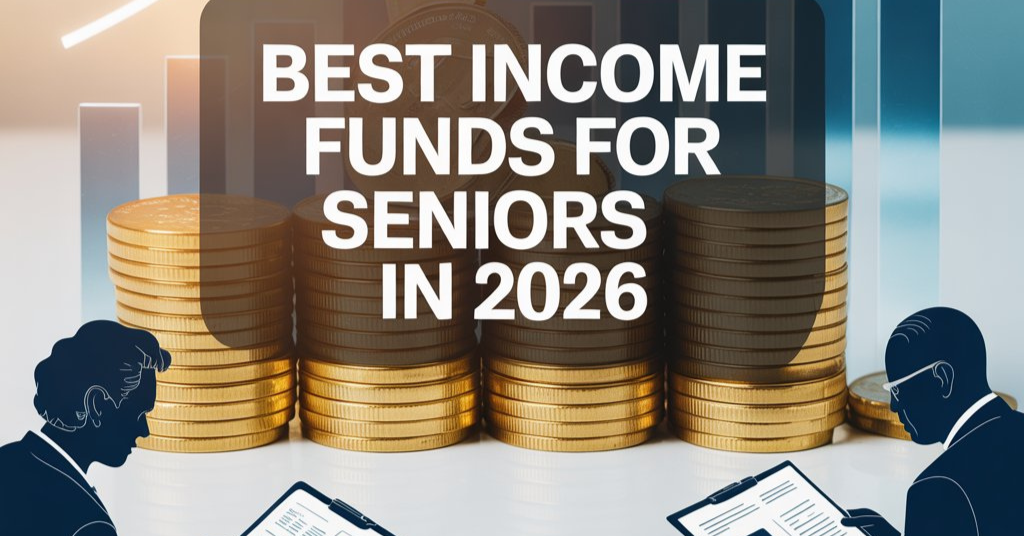
Retirement is not about growing wealth aggressively anymore — it is about creating steady, predictable income while protecting your savings. In 2026, seniors are facing rising living costs, changing interest rates, and market uncertainty. That’s why choosing the best income funds for seniors in 2026 requires careful planning.
This detailed guide will help you understand:
- What income funds are
- Which types are best for seniors
- How much income you can generate
- Real dollar examples and calculations
- How to build a balanced retirement income portfolio
Let’s begin.
Why Income Funds Matter More in 2026
In retirement, your priorities shift:
✔ Regular monthly income
✔ Capital protection
✔ Lower volatility
✔ Inflation protection
✔ Tax efficiency
Suppose a senior has $600,000 saved for retirement. If they simply keep it in a savings account earning 2%, they will earn:
$600,000 × 2% = $12,000 per year
That equals only $1,000 per month before tax.
But if structured properly into income-focused investments averaging 5–6%, the same savings could generate:
$600,000 × 5% = $30,000 per year
That equals $2,500 per month — more than double.
That’s why income funds are so important.
What Are Income Funds?
Income funds are investments designed to produce regular cash payouts through:
- Dividends (from stocks)
- Interest (from bonds)
- Rental income (from property funds)
- Structured withdrawals
They focus on income first, growth second.
Now let’s explore the best options for seniors in 2026.
Best Income Funds for Seniors in 2026
1. Dividend Equity Income Funds
These funds invest in stable companies that regularly pay dividends.
Why They Work for Seniors
- Potential yield: 4%–6%
- Companies often increase dividends over time
- Helps fight inflation
Example Calculation
Let’s assume:
Investment: $400,000
Dividend yield: 5%
$400,000 × 5% = $20,000 per year
That equals:
$20,000 ÷ 12 = $1,667 per month
Even if the stock price fluctuates, dividend income may continue.
Risk Factor
Stock prices can fall during market downturns. That’s why dividend funds should be combined with safer assets.
2. Balanced Advantage / Hybrid Income Funds
These funds combine:
- Stocks (for growth)
- Bonds (for stability)
Typical allocation:
- 40–60% equity
- 40–60% bonds
Expected Returns in 2026
5%–8% depending on market conditions.
Example
Investment: $500,000
Average return: 6%
$500,000 × 6% = $30,000 per year
Monthly income via systematic withdrawal:
$30,000 ÷ 12 = $2,500 per month
Because part of the portfolio is in bonds, volatility is reduced compared to pure equity funds.
3. Bond Funds (Fixed Income Funds)
Bond funds invest in:
- Government bonds
- Corporate bonds
- High-grade debt securities
These are generally safer than stocks.
Typical Yield in 2026
4%–5%
Example
Investment: $300,000
Yield: 4.5%
$300,000 × 4.5% = $13,500 per year
Monthly income:
$13,500 ÷ 12 = $1,125 per month
Bond funds are excellent for seniors who prioritize stability.
4. Monthly Income ETFs
Income-focused ETFs distribute income monthly.
Some strategies include:
- Covered call strategy
- Treasury-based income
- High-dividend equity portfolios
Example
Investment: $250,000
Yield: 6.5%
$250,000 × 6.5% = $16,250 annually
Monthly payout:
$16,250 ÷ 12 ≈ $1,354 per month
These are attractive for seniors who want predictable monthly deposits.
5. Systematic Withdrawal Plan (SWP)
An SWP allows you to withdraw a fixed amount every month while the rest stays invested.
Let’s say:
Investment: $700,000
Expected return: 6%
Desired withdrawal: $3,000 per month
Annual withdrawal:
$3,000 × 12 = $36,000
Expected annual growth:
$700,000 × 6% = $42,000
Since returns ($42,000) exceed withdrawals ($36,000), your capital may continue growing — depending on market performance.
This is one of the smartest retirement income strategies in 2026.
How Much Income Do Seniors Need?
Let’s estimate.
Average monthly retirement expenses:
- Housing: $1,200
- Food: $600
- Healthcare: $800
- Utilities & Insurance: $500
- Travel & Lifestyle: $900
Total: $4,000 per month
Annual need:
$4,000 × 12 = $48,000
If a retiree wants $48,000 annually from investments, and the portfolio yields 5%, they would need:
$48,000 ÷ 5% = $960,000
That means nearly $1 million in capital.
This calculation helps seniors plan realistically.
Sample Retirement Income Portfolio for 2026
Here’s a balanced example for a senior with $1,000,000:
| Investment Type | Allocation | Expected Yield | Annual Income |
| Dividend Equity Fund | $300,000 | 5.5% | $16,500 |
| Bond Fund | $350,000 | 4.5% | $15,750 |
| Hybrid Fund | $250,000 | 6% | $15,000 |
| Income ETF | $100,000 | 6% | $6,000 |
Total Annual Income
16,500 + 15,750 + 15,000 + 6,000 = $53,250
Monthly income:
$53,250 ÷ 12 ≈ $4,437
This portfolio meets the earlier $4,000 monthly goal with extra buffer.
Inflation Impact in 2026
Inflation reduces purchasing power.
If inflation is 3% annually:
$50,000 today will need:
$50,000 × (1.03)^5 ≈ $57,964
in five years.
That’s why including some equity exposure is important — it helps income grow over time.
Risks Seniors Must Consider
1. Market Volatility
Dividend funds may fluctuate in value.
2. Interest Rate Changes
Bond prices fall when rates rise.
3. Longevity Risk
Living longer than expected.
4. Sequence of Returns Risk
Early market losses in retirement can hurt long-term sustainability.
Proper diversification helps manage these risks.
Tax Considerations
Income from:
- Dividends
- Interest
- Capital gains
may be taxed differently depending on country and account type.
For example:
If $50,000 annual income is taxed at 15%:
$50,000 × 15% = $7,500 tax
Net income:
$50,000 – $7,500 = $42,500
Always consider after-tax income when planning.
Conservative vs Moderate Senior Strategy
Conservative Strategy
- 70% bonds
- 30% dividend stocks
- Yield around 4–5%
Moderate Strategy
- 50% bonds
- 40% dividend stocks
- 10% hybrid funds
- Yield around 5–6.5%
Choice depends on:
- Age
- Health
- Risk tolerance
- Other income sources
Best Strategy for Seniors in 2026
Instead of choosing just one fund, combine:
✔ Dividend funds for growth
✔ Bond funds for stability
✔ Hybrid funds for balance
✔ SWP for structured withdrawals
This creates predictable income while managing risk.
Also Read: High Yield Savings Accounts for Retirees: Advisor Guide
Final Thoughts: Building Retirement Income That Lasts
The best income funds for seniors in 2026 are not about chasing the highest yield. They are about:
- Stability
- Consistency
- Diversification
- Sustainability
A senior with $800,000–$1,000,000 invested wisely across income funds can reasonably aim for $40,000–$55,000 annually, depending on allocation and market conditions.
The key is balancing income today with growth for tomorrow.
Retirement is not about taking big risks. It’s about making your money work steadily — month after month — so you can enjoy financial peace of mind.
If you structure your portfolio correctly, income funds can provide exactly that in 2026 and beyond.