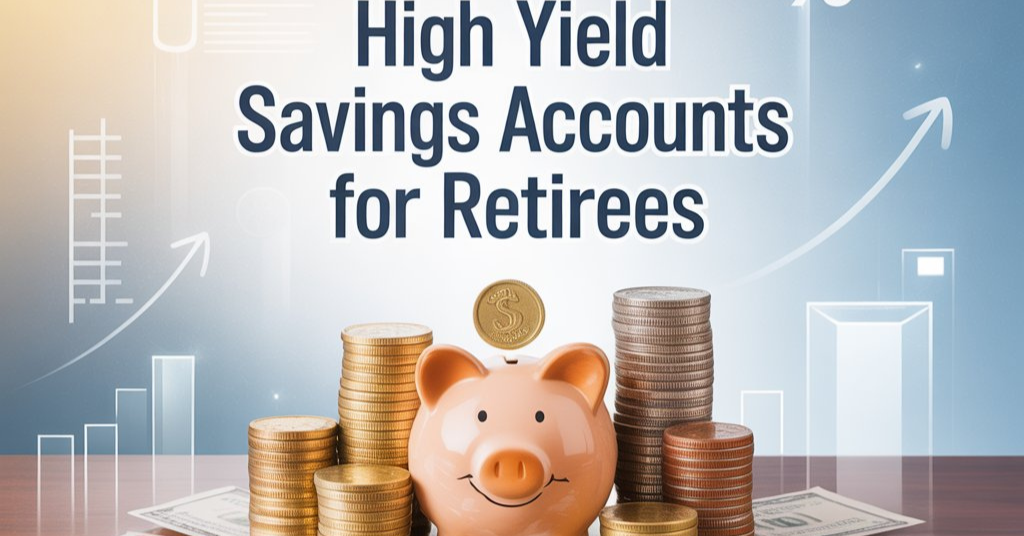
Retirement is about stability, security, and steady income. After decades of working and saving, the last thing you want is unnecessary risk. As your financial advisor, let me walk you through one of the safest and smartest tools available today — High Yield Savings Accounts (HYSAs).
In this detailed guide, I will explain:
- What high yield savings accounts are
- Why retirees should consider them
- How much you can earn (with dollar calculations)
- Tax impact
- How to choose the best account
- Practical strategies to maximize income
Let’s begin with High Yield Savings Accounts for retirees.
What Is a High Yield Savings Account?
A High Yield Savings Account (HYSA) is a savings account that pays a significantly higher interest rate than a traditional savings account.
Traditional savings accounts often pay around 0.10% to 0.50% APY (Annual Percentage Yield). In contrast, high yield savings accounts may offer 4% to 5% APY or more, depending on market conditions.
The key difference is simple:
- Same safety
- Same liquidity
- Much higher return
This makes HYSAs especially attractive for retirees who prioritize capital protection and steady returns.
Why High Yield Savings Accounts Are Ideal for Retirees
As a retiree, your financial priorities are different from someone in their 30s or 40s.
You likely want:
- Protection of your savings
- Easy access to money
- Consistent income
- Low stress and low risk
High yield savings accounts offer all four.
1. Safety
Most HYSAs are insured up to government limits (such as $250,000 per depositor per bank in the U.S.). That means your money is protected if the bank fails.
2. Liquidity
Unlike fixed deposits or CDs, you can usually withdraw your money anytime without penalty.
3. Predictable Returns
The interest is steady. No stock market crashes. No bond price swings.
4. Simplicity
No complicated paperwork, no market tracking, no daily stress.
How Much Can You Earn? (Real Dollar Calculations)
Let’s look at real examples so you can clearly understand the income potential.
Example 1: $50,000 at 4% APY
Interest = Principal × Rate
= $50,000 × 0.04
= $2,000 per year
Monthly income equivalent:
$2,000 ÷ 12 = $167 per month
Example 2: $100,000 at 4.5% APY
$100,000 × 0.045 = $4,500 per year
Monthly equivalent:
$4,500 ÷ 12 = $375 per month
Example 3: $250,000 at 5% APY
$250,000 × 0.05 = $12,500 per year
Monthly equivalent:
$12,500 ÷ 12 = $1,041 per month
This shows how retirees with larger savings can generate meaningful passive income without market risk.
Understanding Compounding: The Hidden Power
Most high yield savings accounts compound interest monthly.
Let’s compare simple vs compounded returns.
Example: $100,000 at 4% for 5 years
Without compounding:
$100,000 × 0.04 × 5 = $20,000
With annual compounding:
Year 1: $104,000
Year 2: $108,160
Year 3: $112,486
Year 4: $116,986
Year 5: $121,665
Total interest earned ≈ $21,665
That’s an extra $1,665 just from compounding.
Over longer periods, compounding becomes even more powerful.
Taxes on High Yield Savings Accounts
Interest earned is generally taxable income.
Let’s say:
- You earn $5,000 in interest
- Your tax bracket is 20%
Tax = $5,000 × 0.20 = $1,000
Net income after tax = $4,000
Even after taxes, the income remains attractive compared to traditional accounts paying almost nothing.
How Much Do You Need to Generate Monthly Retirement Income?
Let’s reverse calculate.
If you want:
$1,000 per month
Annual income needed = $12,000
At 4% APY:
$12,000 ÷ 0.04 = $300,000
$2,000 per month
Annual income needed = $24,000
At 4% APY:
$24,000 ÷ 0.04 = $600,000
$3,000 per month
Annual income needed = $36,000
At 4.5% APY:
$36,000 ÷ 0.045 = $800,000
This formula helps retirees clearly understand how savings translate into income.
Comparing HYSA With Other Retirement Options
Let’s compare risk and reward.
High Yield Savings Account
- Risk: Very Low
- Liquidity: High
- Return: 4–5% (variable)
Certificates of Deposit (CDs)
- Risk: Low
- Liquidity: Locked for term
- Return: Similar but less flexible
Bonds
- Risk: Moderate
- Liquidity: Medium
- Return: 2–4%
Stocks
- Risk: High
- Liquidity: High
- Return: Higher potential but volatile
For retirees who want peace of mind, HYSAs often make more sense for emergency funds and short-term income needs.
Important Factors When Choosing a High Yield Savings Account
As your advisor, here’s what you must check:
1. APY (Annual Percentage Yield)
Higher is better, but make sure it’s not a temporary promotional rate.
2. Fees
Avoid:
- Monthly maintenance fees
- Withdrawal penalties
- Hidden service charges
Even a $10 monthly fee reduces annual earnings by $120.
3. Minimum Balance Requirements
Some accounts require minimum deposits to earn full interest.
Example:
If account requires $10,000 minimum and you keep $9,000, you might earn a much lower rate.
4. Compounding Frequency
Monthly compounding is better than quarterly.
5. Bank Stability
Choose reputable, well-established banks with strong ratings.
Smart Strategy for Retirees: The 3-Bucket Approach
Many retirees use a simple strategy:
Bucket 1: Immediate Cash (HYSA)
6–12 months of expenses.
Bucket 2: Medium-Term Savings (HYSA + CDs)
Money needed in 1–5 years.
Bucket 3: Long-Term Growth (Stocks or Funds)
For inflation protection.
High yield savings accounts fit perfectly into Bucket 1 and Bucket 2.
Protecting Against Inflation
Inflation reduces purchasing power over time.
If inflation is 3% and your savings earn:
- 0.5% → You lose purchasing power
- 4% → You stay ahead
- 5% → You grow modestly above inflation
That’s why HYSAs are much better than traditional savings accounts for retirees.
Risks You Should Know
While very safe, HYSAs have minor considerations:
- Interest rates can drop if central banks lower rates.
- Returns may not always beat inflation in high-inflation years.
- Very large balances above insurance limits need diversification across banks.
But compared to stock market volatility, these risks are small.
Example: Complete Retirement Income Scenario
Let’s imagine:
Retiree savings: $500,000
HYSA rate: 4.25%
Annual interest:
$500,000 × 0.0425 = $21,250
Monthly income equivalent:
$21,250 ÷ 12 ≈ $1,770
After 20% tax:
$21,250 × 0.20 = $4,250 tax
Net income: $17,000
Monthly after tax ≈ $1,417
This income can cover groceries, utilities, insurance, and medical expenses — without touching principal.
That’s the beauty of it.
When Should Retirees Use High Yield Savings Accounts?
You should consider using them if:
- You want zero market stress
- You need emergency funds
- You are in early retirement transition
- You prefer guaranteed returns
- You want monthly income without selling investments
Final Advisor Recommendation
High Yield Savings Accounts are not meant to replace all retirement investments. But they are an essential tool for:
- Stability
- Liquidity
- Passive income
- Peace of mind
As a retiree, your focus should shift from aggressive growth to capital preservation and steady returns. HYSAs offer exactly that balance.
If you have significant savings sitting in a low-interest account earning less than 1%, you may be losing thousands of dollars per year in potential income.
Even moving from 0.5% to 4.5% on $200,000 increases annual income from:
$1,000 → $9,000
That’s an $8,000 difference per year.
Small rate changes create big retirement impact.
Also Read: Best Investment for Retirees During Inflation
Conclusion
High Yield Savings Accounts for retirees provide safety, flexibility, and consistent income. With interest rates much higher than traditional savings accounts, they can significantly improve retirement cash flow.
If used wisely — alongside other retirement strategies — they can help you protect your savings while generating predictable income.
The key is simple:
Choose wisely.
Monitor rates.
Avoid fees.
Stay diversified.
And most importantly — make your money work for you, even in retirement.