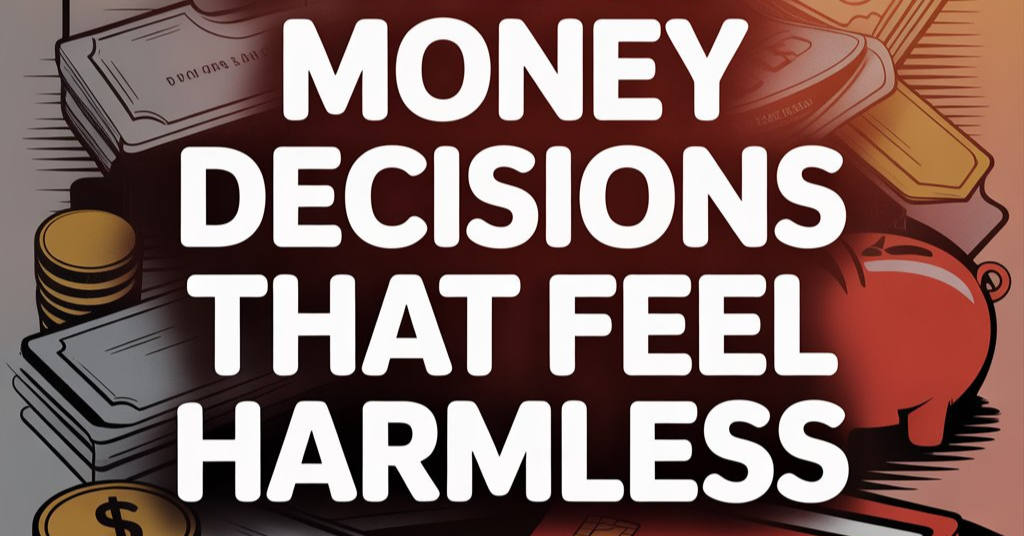
Some financial decisions feel harmless — maybe even smart at the moment. But what seems innocent today can quietly drain your money, harm your future goals, and leave you scrambling later.
In this blog, I’ll walk you through 9 worst money decisions that feel harmless, explain why they hurt your finances, and show real dollar examples so you feel the impact before it’s too late.
Let’s dive in — one by one 👇
9 Worst Money Decisions That Feel Harmless
#1 — Ignoring Your Budget (It feels like freedom)
You might think, “I’ll track my spending later,” or “I know roughly where my money goes,” but not having a strict budget is like driving at night without headlights. You think you’re fine — until you hit a pothole.
👉 Example:
Monthly income: $3,000
Untracked discretionary spending: $800/mo
That’s $9,600/year disappearing without savings or investments. If you budgeted even $400 less per month, and invested it in an index fund earning a 7% return, you’d have roughly $5,000+ after 5 years — free money you almost ignored.
Why it feels harmless: “I know what I spend” or “it’s just small stuff.”
Truth: Small things add up fast.
#2 — Living on Credit Cards (Feels like flexible cash)
Swipe now, think later — that’s the credit trap. All the big banks make it easy to charge first and pay later. But that “later” usually comes with high interest (often 20%+) and fees.
👉 Example:
You spend $1,200 on credit cards this month and only pay the minimum. Interest might cost you $200+ extra in a year — and you’re still paying principal.
Why it feels harmless: “I’ll pay it off later.”
Truth: Interest makes everyday purchases pricier than you think.
#3 — Not Having an Emergency Fund (Feels like optimism)
You might think, “Nothing bad will happen,” but life doesn’t ask permission. Health issues, job losses, car breakdowns — they happen.
👉 Example:
A car repair costs $1,000.
Without savings, you borrow this at 18% interest — costing you $180 extra the first year alone. If you did save that $1,000 and invested it instead at 6%, you could earn $60 just by being prepared.
Why it feels harmless: “I’ll save when I have more.”
Truth: Delaying safety nets costs you money — and peace of mind.
#4 — Ignoring Retirement Savings (Feels far away)
Retirement can seem like a distant idea — especially in your 20s or 30s. But compound interest is real, and delaying even a few years can cost you thousands.
👉 Example:
If you invested $200/mo at age 25 earning 7% until age 65, you’d have ~$265,000. If you waited until age 35 to start, that same monthly amount would grow to only ~$122,000 — less than half!
Why it feels harmless: “I have plenty of time.”
Truth: Time is your most powerful investment ally. Use it.
#5 — Spending to Impress (Social pressure feels normal)
Buying things to match your friends’ lifestyle — trips, gadgets, cars — can feel okay. But this “keeping up” mindset silently drains your resources.
👉 Example:
Weekend trips or new gadgets $300/month = $3,600/yr
If you instead invested that at 6%, in 10 years you’d have $50,000+.
Why it feels harmless: “Everyone does it.”
Truth: Your financial goals matter more than impressions.
#6 — Forgetting Subscriptions & Small Fees (Feels negligible)
Subscription apps, gym memberships, food delivery plans — they seem small. But they stack.
👉 Example:
10 subscriptions at $12/month = $120/mo → $1,440/year
If you canceled even half and invested that instead at 7% over 5 years, you’d see roughly $8,500 in gains and contributions.
Why it feels harmless: “It’s small.”
Truth: Small recurring charges are silent wallet killers.
#7 — Emotional Financial Decisions (Feels satisfying now)
Buying impulsively when you’re happy, sad, or bored may feel good, but emotion-driven purchases often lead to poor outcomes.
👉 Example:
Impulse shopping: $150/week when stressed = $7,800/year
Redirect just half into a retirement or investment account at 6% → over $10,000 after 5 years.
Why it feels harmless: “I needed it today.”
Truth: Instant gratification doesn’t pay future bills.
#8 — Neglecting Insurance (Feels like an unnecessary expense)
Insurance often feels like a cost you don’t benefit from. But when an accident strikes — health, auto, property — that neglected monthly cost can seem tiny.
👉 Example:
Skipping health insurance to save $200/month might cost you $5,000+ if you need treatment once — and that’s a conservative estimate.
Why it feels harmless: “I’m healthy.”
Truth: One accident can wipe years of savings overnight.
#9 — Not Learning About Personal Finance (Feels like studying)
Finance isn’t usually taught in school, so it feels okay to avoid learning it. But that gap slows your wealth growth and exposes you to costly mistakes.
👉 Example:
If someone educated themselves and made just one better decision per year — like avoiding a $1,000 costly mistake — in 10 years, that’s $10,000 saved before investment gains.
Why it feels harmless: “It’s boring.”
Truth: Knowing money basics pays massive dividends over time.
Also Read: Emergency Cash Assistance: Meaning, Benefits, and How It Works
Final Takeaway — Small Decisions = Big Impact
You might think “this one thing won’t matter,” but when repeated — year after year — these harmless choices build up to serious financial regret. The key is awareness: spot the silent drains, understand the cost in real dollars, and replace harmful habits with smarter money habits.Every great money journey starts with small steps. Today you saw the cost. Tomorrow you change the decision. Tomorrow you win.