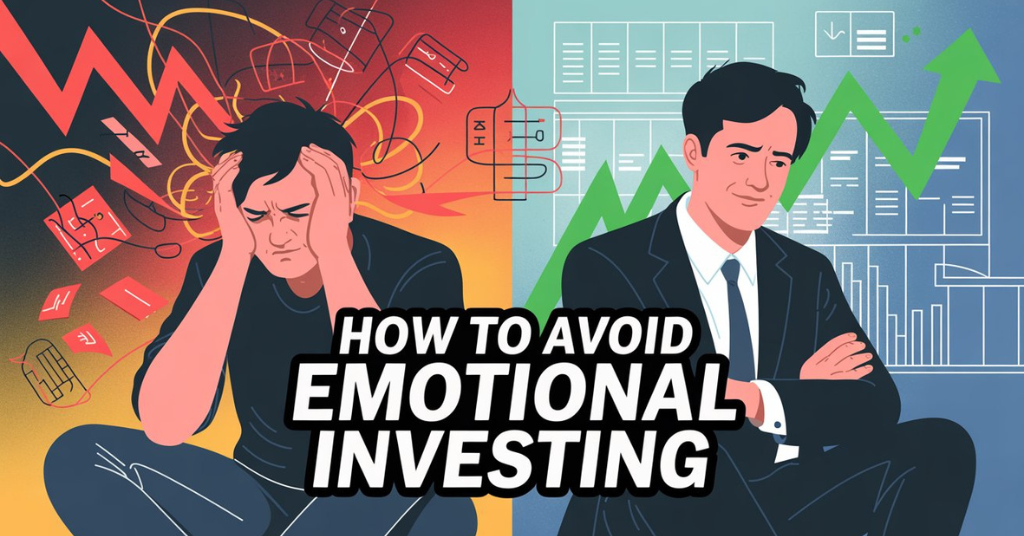
Investing can help you grow money for the future, but it also comes with risks. Many people lose money not because the market is bad, but because their emotions control their decisions. This is called emotional investing, and it is one of the biggest reasons investors buy at the wrong time, sell at the wrong time, or take more risks than they should.
In this detailed, easy-to-read blog, you will learn:
- What emotional investing means
- Why it can be dangerous
- How to avoid emotional investing with simple steps
- Real examples and simple calculations
- How to build a long-term, calm, and successful investment mindset
Let’s start.
What Is Emotional Investing?
Emotional investing means making investment decisions based on feelings, not logic. These emotions can include:
- Fear
- Greed
- Excitement
- Panic
- Overconfidence
- Anxiety
- Impatience
When emotions take over, you might:
- Buy something because it is trending
- Sell in fear when the price drops
- Follow what everyone else is doing
- Try to “time the market”
- Check your portfolio too often
These behaviors often lead to losses.
Real-Life Example of Emotional Investing
Imagine this simple situation:
- A stock price goes up from $100 to $150.
- Everyone starts talking about it.
- You get excited and buy at $150.
But after two weeks:
- The price drops back to $110.
- You panic and sell at $110.
Your loss = $150 – $110 = $40 per share
You bought because of excitement and sold because of fear.
This is emotional investing.
Why Emotional Investing Is Harmful
1. You Buy High and Sell Low
This is the opposite of the correct strategy.
The right way is: buy low, sell high.
Emotions make you do the reverse.
2. You React to Short-Term Market Noise
Markets go up and down daily.
Reacting to every drop or rise causes bad decisions.
3. You Ignore Long-Term Growth
Most wealth is built over years, not days.
Emotional investors think only about today.
4. You Miss Opportunities
If you panic during a fall, you might sell just before the market recovers.
Example:
If you invested $1,000 in a fund and it drops by 10%, you see $900.
You panic and sell.
But if the market goes back up by 10%, you would now get:
900 × 1.10 = $990, not the original $1,000.
You lose money simply because you reacted emotionally.
Common Emotions That Ruin Investing
1. Fear of Losing Money
You sell too early.
2. Greed of Making Money Fast
You buy risky assets or follow hype.
3. Overconfidence
You take more risk than needed.
4. Impatience
You want quick results instead of long-term returns.
5. Social Pressure
You follow what friends, social media, or trending news says.
Understanding these emotions is the first step in controlling them.
How To Avoid Emotional Investing — Simple and Effective Strategies
Below are very practical steps that anyone—including beginners—can follow.
1. Set Clear Long-Term Financial Goals
When you know why you are investing, you stay calm.
Examples of long-term goals:
- Retirement
- Buying a home
- Children’s education
- Wealth creation
When you focus on goals, short-term market changes don’t scare you.
Example
If your goal is to invest for 15 years, a small drop today does not matter.
If your investment of $5,000 drops 5%, you see $4,750.
But in 15 years, that same investment can grow like this:
If average return = 8% per year
Future value =
= $5,000 × (1.08)^15
= $15,865 (approx.)
A temporary drop doesn’t affect a strong long-term plan.
2. Create a Written Investment Plan
A written plan is also called an investment policy statement.
It helps you stay disciplined and avoid emotional decisions.
Your written plan should include:
✔ Your goals
✔ Your risk level
✔ Your time horizon
✔ What percentage you will invest in different assets
✔ How often you review your investments
When emotions strike, your written plan guides you better than your mood.
3. Start Using Automatic Investing (Systematic Investing)
Automating your investments removes emotions.
This can be done by:
- Automatic monthly transfers
- Automated mutual fund plans
- Robo-advisors
Automation helps you invest consistently.
Example
If you invest $200 per month, you will buy at different prices:
- When the market is high
- When it is low
- When it is average
This strategy is called Dollar-Cost Averaging (DCA).
Let’s understand with a small calculation:
| Month | Investment | Price per Unit | Units Bought |
| Jan | $200 | $20 | 10 |
| Feb | $200 | $10 | 20 |
| Mar | $200 | $25 | 8 |
Total invested = $600
Total units bought = 38 units
Average cost per unit = $600 / 38 = $15.79
Even though prices were up and down, your average cost remains stable.
This avoids emotional timing mistakes.
4. Diversify Your Investments
Diversification means:
Don’t put all your money into one type of investment.
Spread your money across:
- Stocks
- Bonds
- Index funds
- Real estate funds
- Gold
- International funds
If one investment falls, others may rise.
Simple Example
You invest $10,000 like this:
- 50% in stocks → $5,000
- 30% in bonds → $3,000
- 20% in gold → $2,000
Now imagine:
- Stocks fall by 10% → you lose $500
- Bonds rise by 5% → you gain $150
- Gold rises by 8% → you gain $160
Total portfolio change:
= –500 + 150 + 160
= –190
Your loss is only $190, not $500.
This is the power of diversification.
5. Stop Checking Your Investments Too Often
Checking your portfolio daily causes fear and stress.
It makes you want to change something even when you shouldn’t.
Best practice:
✔ Check once a month
✔ Review deeply once every 6 months
This gives you mental peace and prevents emotional decisions.
6. Avoid Following Market Hype
Social media, news channels, and friends often create panic or excitement.
But hype leads to buying overpriced investments or selling at the wrong time.
Always do your own analysis.
Ask simple questions:
- Why am I buying this?
- Does it match my goals?
- What is the risk?
- Am I buying because others are buying?
Write answers.
If you cannot explain why you’re buying, don’t buy.
7. Understand Your Investor Personality
People have different investor types:
- Conservative
- Aggressive
- Balanced
- Emotional
- Risk-taking
- Fearful
Knowing your personality helps you choose the right strategies.
For example:
If you are naturally anxious, choose more stable investments like:
- Bonds
- Index funds
- Blue-chip stocks
If you are adventurous, choose a mix of:
- Stocks
- Sector funds
- Managed portfolios
Knowing yourself helps you avoid emotional mistakes.
8. Use the “10-Minute Rule” Before Making Decisions
If you feel the urge to buy or sell:
✔ Stop
✔ Wait for 10 minutes
✔ Think logically
✔ Review your plan
✔ Ask: “Am I reacting to emotion?”
This simple method can prevent panic decisions.
9. Build an Emergency Fund
If you don’t have emergency savings, you may withdraw investments during stress.
Recommended emergency fund:
3 to 6 months of expenses
Example:
If your monthly expense is $1,000
Emergency fund = $3,000 to $6,000
This prevents emotional selling when unexpected expenses come.
10. Focus on Long-Term Returns, Not Short-Term Fluctuations
Markets move daily, but long-term returns are more stable.
For example:
If you invest $10,000 for 20 years at 8% return:
Future value:
= $10,000 × (1.08)^20
≈ $46,600
Even if the market has many ups and downs, long-term investing wins.
11. Keep a Simple Investment Journal
Write down:
- Why you bought something
- At what price
- What you expect
- When you will review
When emotions rise, reading your journal helps you stay calm.
12. Take Professional Advice If Needed
If you feel overwhelmed, talk to a financial advisor.
They provide guidance based on logic, not emotion.
Summary Table: How to Avoid Emotional Investing
| Strategy | Why It Helps |
| Set long-term goals | Helps you ignore daily fluctuations |
| Automatic investing | Removes emotional decisions |
| Diversification | Reduces risk and protects returns |
| Limit portfolio checking | Reduces fear and stress |
| Investment plan | Keeps decisions logical |
| Avoid hype | Prevents panic buying or selling |
| Emergency fund | Stops forced selling |
| Long-term focus | Builds real wealth |
Also Read: Is Finance a Lot of Math? A Simple Guide
Conclusion
Emotional investing is one of the biggest reasons people lose money in markets.
But with the right strategies—like setting goals, diversifying, investing regularly, limiting portfolio checks, and staying focused on the long term—you can avoid emotional mistakes and grow your wealth steadily.
Remember, successful investing is not about being perfect.
It is about staying patient, calm, and consistent.
If you follow the steps in this blog, you will make smarter decisions, avoid emotional traps, and build a strong financial future.