If you are new to investing, you may be confused: Should I buy index funds or individual stocks?
Both options can help you grow money, but they work in different ways and carry different levels of risk.
In this simple guide, we will explain:
- What is a stock?
- What is an index fund?
- How are index funds and stocks different?
- Which one is safer for beginners: Index Funds vs Stocks explained simply?
- Examples and small calculations to understand returns
- How to choose between index funds and stocks
Language will be very easy, so even a complete beginner can understand.
What Are Stocks?
A stock is a small piece of a company.
- When you buy a stock, you become a part-owner of that company.
- If the company earns good profit and grows, the value of your stock can go up.
- If the company does badly, the value of your stock can go down.
Example: Owning one company’s stock
Imagine a company called Bright Tech Ltd.
- You buy 10 shares of Bright Tech at $20 per share.
- Your total investment = 10 × $20 = $200.
Now, after 1 year:
- If the share price goes up to $30,
- Your investment value = 10 × $30 = $300
- Profit = $300 − $200 = $100 (50% return)
- If the share price falls to $12,
- Your investment value = 10 × $12 = $120
- Loss = $200 − $120 = $80 (−40% return)
So, with individual stocks:
- You can earn very high returns, but
- You can also face big losses if that one company performs badly.
What Are Index Funds?
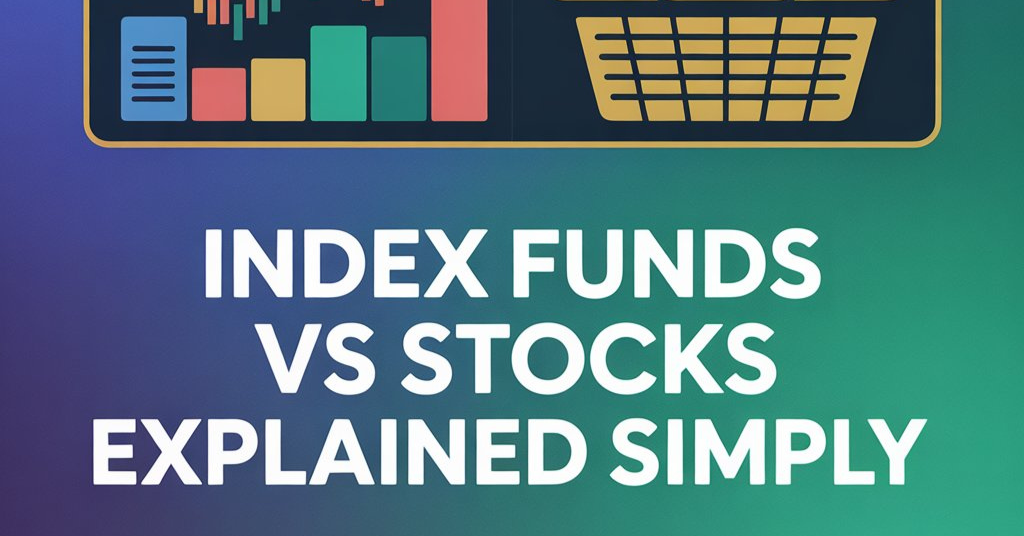
An index fund is a type of investment that holds many different stocks together in one basket.
- It is designed to copy the performance of a market index like:
- S&P 500 (500 large companies)
- Dow Jones Industrial Average
- Or other stock market indexes
When you buy one unit of an index fund, you are indirectly buying small pieces of many companies at the same time.
Simple way to understand
Think of an index fund like a fruit basket:
- A stock = 1 apple or 1 orange
- An index fund = a basket with apples, oranges, bananas, grapes, etc.
If one fruit (one company) goes bad, the whole basket still has many good fruits. So your risk is spread out. This is called diversification.
Index Funds vs Stocks: Key Differences (Simplified)
Let’s compare them point by point.
a) Risk
- Stocks:
- Higher risk.
- If you choose one or a few companies and they fail, you can lose a lot of money.
- Index Funds:
- Lower risk compared to single stocks.
- Your money is spread across many companies, so one company’s failure usually has a small impact.
b) Return Potential
- Stocks:
- Can give very high returns if you pick winning companies.
- But results depend on your research and timing.
- Index Funds:
- Aim to give average market return.
- You may not beat the market, but you usually won’t do extremely badly if you stay invested for long.
c) Time and Effort
- Stocks:
- Need more time, research, and attention.
- You should read company news, results, and understand the business.
- Index Funds:
- More hands-off.
- You don’t need to track each company.
- Good for busy people or beginners.
d) Costs
- Stocks:
- You may pay a brokerage fee whenever you buy or sell.
- No yearly management fee on the stock itself.
- Index Funds:
- You pay a small annual expense ratio (management fee), but usually it is very low for index funds.
- Lower cost than many actively managed mutual funds.
Simple Return Example: Index Fund vs One Stock
Let’s see a small calculation over 10 years.
Scenario A: You pick one stock
- You invest $1,000 in a single company’s stock.
- Suppose that company does very well and grows at 12% per year.
We use the compound interest formula:
Future Value = Present Value × (1 + r)^n
Where:
- r = annual growth rate
- n = number of years
So:
Future Value = 1000 × (1 + 0.12)^10
(1.12)^10 is roughly 3.105
Future Value ≈ 1000 × 3.105 = $3,105
So in 10 years, your $1,000 becomes about $3,105 if your stock grows 12% every year.
But if your chosen company fails and grows at 0% or even goes down, your value may become:
- At 0% growth: still around $1,000
- At −5% growth per year:
Future Value = 1000 × (0.95)^10 ≈ 1000 × 0.599 = $599
So, with one stock, the range could be from around $599 to $3,105 or even worse/better, depending on the company.
Scenario B: You choose a broad index fund
Now you invest $1,000 in a broad market index fund.
Historically, many large stock market indexes have given around 7–10% per year over the long term (after inflation the number is a bit lower, but we’ll keep it simple).
Let’s assume 8% per year average return.
Future Value = 1000 × (1 + 0.08)^10
(1.08)^10 ≈ 2.159
Future Value ≈ 1000 × 2.159 = $2,159
So with an index fund at 8%:
- Your $1,000 grows to about $2,159 in 10 years.
- This is less than the “perfect” stock pick (which gave $3,105)
- But more than a bad or weak stock (which might fall to $599).
This shows:
Stocks can give higher returns if you choose very well.
Index funds usually give steady, average returns with lower risk.
Pros and Cons of Investing in Stocks
Advantages of Stocks
- High Return Potential
If you pick strong companies early, your money can grow many times over. - Ownership and Voting Rights
You become a part-owner. In some companies, you may get voting rights in shareholder meetings. - Dividends
Some companies pay dividends, which is regular cash paid to shareholders.
Disadvantages of Stocks
- High Risk
One bad decision can cause big losses. Companies can fail, get into debt, or lose market share. - Need for Research
You must understand the company’s business, financial reports, and competition. - Emotional Stress
Stock prices move daily. It is easy to panic during market falls and make bad decisions.
Pros and Cons of Investing in Index Funds
Advantages of Index Funds
- Diversification (Risk Spread Out)
Your money is spread across many companies. One company’s failure doesn’t destroy your whole investment. - Low Cost
Index funds usually have low expense ratios compared to actively managed funds. - Simple and Time-Saving
You don’t need to choose individual companies. You just choose an index fund and keep investing regularly. - Good for Long-Term Goals
Because they track the market, index funds are good for long-term goals like retirement, education, or wealth building.
Disadvantages of Index Funds
- No Chance to Beat the Market Big
Index funds only try to match the market, not beat it. If you want very high returns from a few “star” companies, index funds will feel average. - Still Linked to Market Risk
If the whole market falls (like in a crash), your index fund will also fall, though you are still diversified. - Less Control
You cannot choose which companies are inside the index fund. You get the full basket.
Who Should Choose Index Funds?
Index funds are usually better for:
- Beginners who don’t understand stock picking yet.
- Busy people who don’t have time to study individual companies.
- Long-term investors who want steady growth over 10, 20, or 30 years.
- People with low to moderate risk tolerance who don’t want big ups and downs from one or two companies.
If you want to “set it and forget it,” index funds are often a good choice. Many experts suggest regular investments (like monthly investing) in index funds to build wealth slowly and safely over time.
Who Should Choose Individual Stocks?
Individual stocks might be suitable for:
- People who enjoy research and analysis
- Investors who understand:
- Financial statements
- Company business models
- Market competition
- People who can handle risk and volatility
- Those who can diversify by buying many different stocks (not just 1–2)
Even then, many experienced investors keep a large part of their portfolio in index funds and use only a small portion for stock picking, like:
- 80% in index funds
- 20% in individual stocks
Simple Portfolio Example: Mix of Index Funds and Stocks
Let’s say you have $5,000 to invest.
You decide:
- 70% in index funds
- 30% in individual stocks
Step 1: Index Fund Investment
70% of $5,000 = 0.70 × 5,000 = $3,500
You put this $3,500 into a broad index fund and plan to keep it for 10+ years.
If this grows at 8% per year for 10 years:
Future Value = 3500 × (1.08)^10 ≈ 3500 × 2.159 = $7,556.5 (approx.)
Step 2: Individual Stock Investment
30% of $5,000 = 0.30 × 5,000 = $1,500
You pick 3 companies:
- Company A: $500
- Company B: $500
- Company C: $500
Let’s imagine after 10 years:
- Company A grows by 10% per year
- Company B grows by 5% per year
- Company C falls by 3% per year
Future Value:
- Company A: 500 × (1.10)^10 ≈ 500 × 2.594 = $1,297
- Company B: 500 × (1.05)^10 ≈ 500 × 1.629 = $814.5
- Company C: 500 × (0.97)^10 ≈ 500 × 0.737 = $368.5
Total from stocks ≈ 1,297 + 814.5 + 368.5 = $2,480
Step 3: Total Portfolio After 10 Years
- Index fund part ≈ $7,556.5
- Stocks part ≈ $2,480
Total ≈ 7,556.5 + 2,480 = $10,036.5
Your original $5,000 has roughly doubled to around $10,000 in this mixed strategy.
This is just an example, not a promise. Real markets move differently. But it shows how:
- The index fund part gave stability and steady growth.
- The stock part added some extra growth but also more risk.
How to Decide: Index Funds vs Stocks (Step-by-Step)
Ask yourself these questions:
- How much time can I spend on research?
- No time? → Prefer index funds.
- Enjoy reading about companies? → You can add some individual stocks.
- How much risk can I handle emotionally?
- If big ups and downs scare you, index funds are better.
- If you are okay with seeing your investments go up and down, you may handle stocks.
- What is my investment goal?
- Long-term goals (retirement, education, wealth building) → index funds work very well.
- Short-term “quick money” desires → stocks are risky and not recommended for short-term.
- Am I a beginner?
- Beginners usually do best starting with index funds and learning slowly.
Also Read: How to Start Investing With Little Money?
Final Thoughts: Which Is Better?
There is no one perfect answer for everyone. But in simple words:
- Index funds are:
- Easier to understand
- Less risky
- More suitable for most everyday investors
- Great for long-term, steady growth
- Individual stocks are:
- Riskier and more volatile
- Can give higher returns if you choose well
- Better for people who have knowledge, time, and strong risk tolerance
For many people, a combination works best:
Use index funds as your foundation and, only if you want, add a small portion of carefully chosen stocks.
Investing is not about getting rich overnight. It is about growing your money slowly and safely over time. Understanding the simple difference between index funds and stocks can help you make smarter, calmer decisions with your hard-earned money.