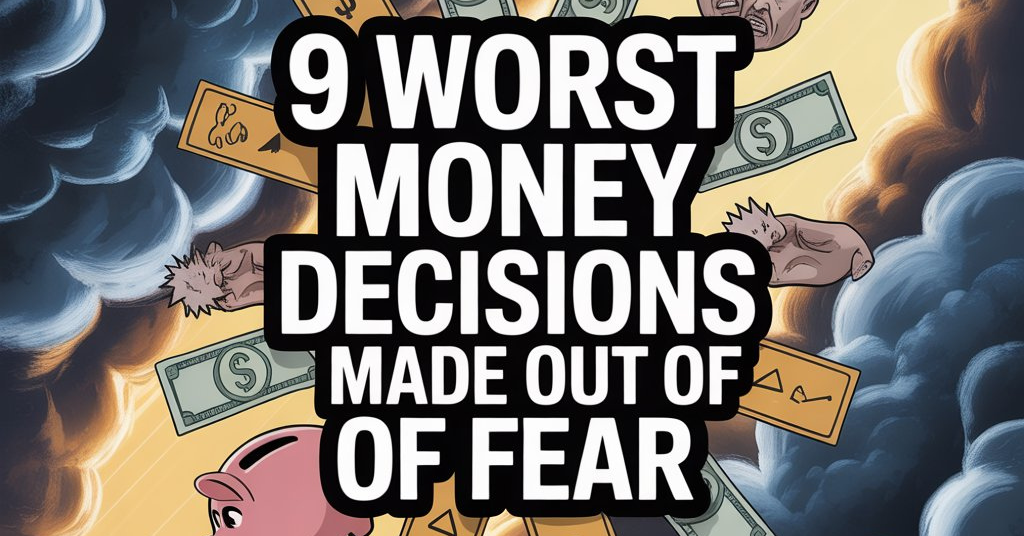
Most people don’t make bad money decisions because they lack knowledge. They make them because fear takes control. Fear of losing money, fear of market crashes, fear of making the wrong move — and slowly, these fears damage finances more than any recession ever could. I’ve seen smart people lose thousands of dollars simply by reacting emotionally instead of thinking long term. This interactive guide is designed to walk you through the 9 worst money decisions made out of fear, one step at a time.
You’ll see real-life examples, simple dollar calculations, and practical advice to help you avoid costly mistakes. Let’s take back control of your money.
9 Worst Money Decisions Made Out of Fear
👉 #1: Panic Selling During Market Drops
What it is:
Selling investments when the market drops — usually because you’re afraid of losing more.
Why it’s a mistake:
Markets fluctuate. Selling at a low locks in losses instead of giving time for recovery.
Example with dollars:
Imagine you bought stock at $30,000. A market downturn makes it fall to $24,000 (a 20% drop). You panic and sell.
- You now realize a $6,000 loss.
- If historically the market rebounded by 30% afterward, you missed future gains.
- If you had held and it recovered to $31,200, your investment would be worth $31,200 — a $1,200 gain over your original amount.
📌 Lesson: Fear-based selling often cuts your gains and guarantees losses.
👉 #2: Keeping Too Much Cash at Low Interest
What it is:
Leaving funds in savings accounts that earn near-zero interest because you’re afraid of risk.
Why it’s a mistake:
Your money loses value over time due to inflation.
Example with dollars:
You keep $50,000 in a basic savings account earning 0.5% annual interest.
- After 1 year:
Interest earned = $50,000 × 0.005 = $250 - But if inflation is 3%, your money’s purchasing power drops by roughly $1,500.
📌 Net Effect: You think you’re safe, but your real wealth decreases.
Smarter alternative:
Allocate some to low-risk investments like high-yield savings or government bonds with higher returns.
👉 #3: Holding On to Bad Investments Out of Hope
What it is:
Refusing to sell underperforming assets because you fear realizing losses.
Why it’s a mistake:
“Hope” isn’t a strategy. This locks money that could be better used elsewhere.
Example with dollars:
You bought a fund at $10,000 that’s now worth $7,000.
- You keep it hoping it’ll bounce back.
- Meanwhile, a more stable investment could make 5% per year.
- Opportunity cost:
$10,000 × 0.05 = $500 per year gain lost by holding the bad asset.
📌 Lesson: Don’t let fear of loss stop you from making strategic decisions.
👉 #4: Cashing Retirement Funds Early
What it is:
Withdrawing from retirement accounts early due to fear of future uncertainty.
Why it’s a mistake:
You pay penalties, taxes, and lose future compounded growth.
Example with dollars:
Withdraw $20,000 early from a retirement account:
- Early withdrawal penalty: ~10% → $2,000
- Taxes (assume 22%): $4,400
- Net received: $13,600
Now consider the long-term loss:
If left invested with a 7% annual return for 20 years:
- Future value of $20,000 = $20,000 × (1.07^20) ≈ $77,000
📌 Actual loss: You lose over $60,000+ in future growth, plus penalties/taxes.
👉 #5: Avoiding Insurance to Save Money Today
What it is:
Skipping insurance (health, auto, home) to save premiums because you’re afraid of spending now.
Why it’s a mistake:
Insurance protects against catastrophic expenses.
Example with dollars:
You skip health insurance to save $300/month → $3,600/year.
Then you face a medical emergency costing $30,000.
- Without insurance: You owe $30,000
- With insurance (even with deductible): Costs might be $2,000–$5,000
📌 Net Pain: You saved $3,600 but risked tens of thousands.
👉 #6: Waiting to Invest Until “Perfect Timing”
What it is:
Delaying investing because you’re scared of picking the wrong moment.
Why it’s a mistake:
Time in the market beats timing the market.
Example with dollars:
You delay investing $25,000 for 3 years waiting for “perfect timing.”
- If returns average 7%:
Future value missed over 3 years ≈ $25,000 × (1.07^3 – 1) ≈ $5,250
📌 Opportunity Cost: $5,250 of gains missed.
Better mindset: Start small now and continue consistently.
👉 #7: Paying Off Only Minimum on High-Interest Debt
What it is:
Paying just the minimum monthly balance because you fear not having cash on hand.
Why it’s a mistake:
Interest compounds, debt grows slowly but surely.
Example with dollars:
You owe $10,000 on a credit card averaging 20% APR.
- If you pay only the minimum each month, it could take 10+ years and cost $12,000+ in interest.
But paying more aggressively:
- If you pay $300/month:
You may clear it in ~3 years, interest ~$3,000
📌 Big difference: You save thousands and ditch debt faster by not being afraid to tackle it.
👉 #8: Buying Too Much “Safe” but Low-Growth Stuff
What it is:
Putting almost all your portfolio in super-safe, ultra-low-return investments because you fear risk.
Why it’s a mistake:
Your money hardly grows, especially after inflation.
Example with dollars:
You put $100,000 in ultra-conservative assets earning ~2% per year.
- After 10 years:
Future value ≈ $100,000 × (1.02^10) ≈ $121,900
Now compare with moderate-risk diversified mix at ~6%:
- Future value ≈ $100,000 × (1.06^10) ≈ $179,000
📌 Big takeaway: You missed over $57,000 in potential gains.
👉 #9: Letting Fear Stop Important Conversations About Money
What it is:
Avoiding talking about finances with a partner, advisor, or family because you’re afraid of conflict or judgment.
Why it’s a mistake:
Communication builds plans, aligns goals, and avoids surprises.
Example:
A couple never discusses retirement planning. One assumes the other handles it. Years pass. They realize too late they haven’t saved enough.
- If they started saving $500/month at age 30 → might have $200,000+ by age 60.
- Because they delayed until age 40: they may only have ~$100,000–$120,000.
📌 Loss here isn’t a simple dollar figure — it’s lost time and missed compound growth.
Also Read: What Are Some Ways That Someone Can Save Money on Their Rent?
🎯 Final Takeaways (Your Fear-Proof Money Plan)
Now you’ve seen the 9 worst money decisions driven by fear — and the true costs behind them. Let’s summarize your best smart-money strategies:✅ Stay invested when fundamentals are solid — don’t sell at lows.
✅ Balance safety and growth — too much cash leaks value.
✅ Cut poor investments — don’t cling to them.
✅ Avoid early withdrawals when possible.
✅ Insure what matters to prevent financial ruin.
✅ Invest consistently instead of waiting for perfection.
✅ Pay down high-interest debt aggressively.
✅ Diversify — don’t sacrifice all growth for “safety.”
✅ Communicate about money early and often.