Finance is the heart of every economy, business, and household. Every time we earn, spend, save, invest, or borrow money — we are part of the financial system.
But have you ever wondered what finance really means and what are the 4 areas of finance?
In simple words, finance is the management of money. It includes how people, companies, and governments raise funds, use them, and plan for the future.
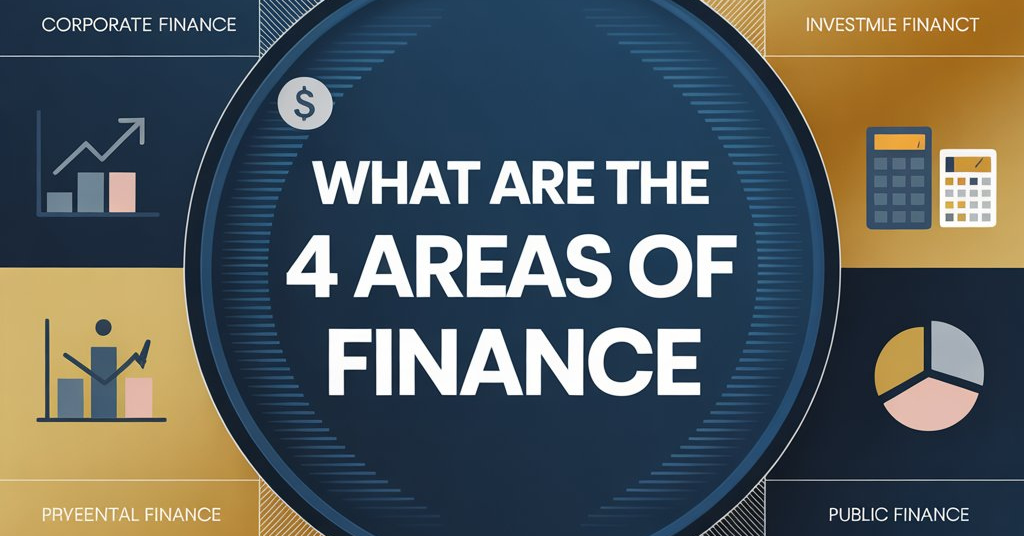
To understand it deeply, experts have divided finance into four main areas:
- Corporate Finance
- Investment Finance
- Financial Institutions & Markets
- International Finance
In this blog, we’ll explore each of these areas in detail with clear explanations, real-life examples, and step-by-step calculations in dollars — so even beginners can easily understand.
What Are the 4 Areas of Finance?
🧾 1. Corporate Finance
✅ What Is Corporate Finance?
Corporate finance is the area of finance that focuses on how companies make money-related decisions.
It deals with:
- How to raise capital (through shares, bonds, or loans)
- How to invest in profitable projects
- How to manage day-to-day cash
- How to distribute profits to shareholders
In short, corporate finance helps businesses grow by planning where to get money and how to use it wisely.
💼 Example of Corporate Finance
Let’s say a company wants to buy new machinery for $100,000.
The machine is expected to generate $28,000 in cash each year for 5 years.
The company expects at least 10% return per year (this is called the “required rate of return”).
Should the company buy the machine?
We’ll find out using the Net Present Value (NPV) method.
📊 NPV Calculation
| Year | Cash Flow ($) | Present Value Factor (10%) | Present Value ($) |
| 1 | 28,000 | 0.909 | 25,452 |
| 2 | 28,000 | 0.826 | 23,128 |
| 3 | 28,000 | 0.751 | 21,028 |
| 4 | 28,000 | 0.683 | 19,124 |
| 5 | 28,000 | 0.621 | 17,388 |
| Total PV | $106,120 |
Now,
NPV = Total PV – Initial Cost
= $106,120 – $100,000 = $6,120 (Positive)
✅ Decision: Since NPV is positive, the company should invest.
This shows how corporate finance helps make investment decisions logically.
🧠 Key Points of Corporate Finance
- Helps decide how to fund projects (loan vs equity).
- Focuses on maximizing company value.
- Involves risk analysis and budgeting.
- Includes dividend decisions (profit sharing).
So, corporate finance is like the brain of a company that ensures every dollar is used smartly.
📈 2. Investment Finance
✅ What Is Investment Finance?
Investment finance focuses on where and how individuals or institutions invest their money to earn returns in the future.
It includes choosing between options like:
- Stocks
- Bonds
- Real estate
- Mutual funds
- Exchange-traded funds (ETFs)
The main goal is to maximize returns while keeping risk under control.
💰 Example of Investment Finance
Suppose you have $10,000 to invest for one year.
You have two options:
| Option | Type | Expected Return | Risk Level |
| A | Government Bond | 5% | Low |
| B | Tech Company Stock | 12% | High |
If you choose Option A,
you’ll earn $10,000 × 5% = $500.
If you choose Option B,
you may earn $10,000 × 12% = $1,200,
but if the stock performs poorly, you might lose 10% ($1,000).
So, the expected return is higher for the stock, but so is the risk.
This balance between risk and return is what investment finance helps you understand.
📊 Portfolio Example
Many investors mix assets to reduce risk.
Suppose you invest 60% in bonds and 40% in stocks.
| Investment | Amount ($) | Return | Weighted Return |
| Bonds | 6,000 | 5% | 0.05 × 0.6 = 3% |
| Stocks | 4,000 | 12% | 0.12 × 0.4 = 4.8% |
| Total Portfolio Return | 10,000 | 7.8% |
So your portfolio may earn around 7.8% average return — lower than pure stocks, but with less risk.
This is the core idea of diversification in investment finance.
🧠 Key Points of Investment Finance
- Teaches how to evaluate risk vs return.
- Helps in asset allocation (how much to invest in what).
- Uses tools like expected value, standard deviation, and CAPM.
- Encourages diversification to reduce losses.
- Guides both individuals and institutions (like mutual funds).
🏛️ 3. Financial Institutions and Markets
✅ What Are Financial Institutions & Markets?
This area covers how money moves through the economy — via banks, credit unions, insurance companies, and financial markets.
Think of it as the bridge that connects people who have money (savers) with those who need it (borrowers).
💡 Types of Financial Institutions
- Banks: Lend money and accept deposits.
- Insurance Companies: Manage risks by offering protection plans.
- Investment Firms: Help investors buy and sell assets.
- Credit Unions: Provide small loans to members.
- Stock Exchanges: Allow trading of shares and bonds.
Financial markets are the platforms where buying and selling happen — like the New York Stock Exchange (NYSE) or NASDAQ.
💰 Example of Financial Institution
Let’s say you deposit $5,000 in a savings account at a 4% annual interest rate.
After one year:
Interest = $5,000 × 4% = $200
So your balance becomes $5,200.
The bank then lends that same $5,000 to another customer at 10% interest.
The bank earns $5,000 × 10% = $500.
Its profit margin is $500 – $200 = $300.
That’s how financial institutions make money — by acting as intermediaries between savers and borrowers.
📊 Example of Financial Market
You buy 100 shares of a company at $50 each = $5,000.
After 6 months, the price increases to $60.
If you sell, you make a profit of $1,000 (100 × $10).
If the price drops to $45, you lose $500.
The stock market enables these transactions instantly — showing the power of liquid markets.
🧠 Key Points of Financial Institutions & Markets
- They move funds from savers to borrowers.
- Provide loans, insurance, and investment services.
- Help in price discovery of financial assets.
- Ensure liquidity (easy buying/selling).
- Are regulated to protect investors and maintain stability.
Without these institutions and markets, the economy would slow down because money couldn’t flow smoothly.
🌎 4. International Finance
✅ What Is International Finance?
International finance deals with financial activities across borders.
It studies how countries, companies, and investors manage money in the global market.
It includes:
- Exchange rates (USD to Euro, USD to INR, etc.)
- Foreign investments
- Global trade and payments
- Currency risk management
- International loans and banking
💵 Example of Exchange Rate Risk
Suppose an American company wants to buy raw materials from Germany for €50,000.
The current exchange rate is 1 € = $1.10, so cost = 50,000 × 1.10 = $55,000.
If the euro strengthens to 1 € = $1.20,
the cost rises to 50,000 × 1.20 = $60,000.
That’s an extra $5,000 loss just because of currency fluctuation!
To protect against this, companies use hedging — locking the exchange rate in advance.
🌐 Example of International Investment
You invest $5,000 in Japanese stocks when $1 = ¥100.
So your investment = ¥500,000.
After one year, the stock value increases by 10% → ¥550,000.
But now the exchange rate changes to $1 = ¥110.
When you convert back:
$ value = ¥550,000 ÷ 110 = $5,000.
Even though the stock rose 10%, you earned 0% in USD because of currency change.
This shows how exchange rates affect international returns.
🧠 Key Points of International Finance
- Deals with foreign exchange and cross-border funds.
- Includes concepts like currency risk and hedging.
- Helps multinational companies plan investments globally.
- Supports trade and economic growth between nations.
- Uses tools like forward contracts, swaps, and derivatives to manage risk.
🔄 How the Four Areas of Finance Work Together
Even though these areas are studied separately, they are all interconnected.
| Finance Area | Main Focus | Real-Life Example |
| Corporate Finance | How a company raises and invests money | A firm deciding to buy new equipment |
| Investment Finance | Where to invest funds for best return | An individual buying stocks or bonds |
| Financial Institutions & Markets | How money flows through banks and exchanges | A bank lending money or stock market trading |
| International Finance | Managing money across countries | A company dealing in imports or exports |
🔗 Example of Connection
A company (Corporate Finance) may raise money by issuing shares in the stock market (Financial Markets).
Investors (Investment Finance) buy these shares expecting a return.
If the company expands globally, it faces exchange rate risks (International Finance).
So all four areas work together like parts of one system — each supporting the other.
💡 Why Understanding These Areas Matters
Whether you are a student, investor, or business owner, understanding these four areas of finance helps you:
- Make smarter decisions — Know where to invest, borrow, or save.
- Manage risks better — Identify currency, market, and investment risks.
- Improve profitability — Use funds efficiently in your business.
- Plan globally — Understand how international trade affects you.
- Grow wealth — Use investment principles for long-term goals.
Finance is not just for experts — anyone can learn to manage money with basic knowledge and simple calculations.
🧮 Real-Life Mini Calculation Recap
| Concept | Example | Result |
| Corporate Finance (NPV) | Machine cost $100,000; cash inflows $28,000 × 5 years @10% | NPV = +$6,120 (Good investment) |
| Investment Finance | $10,000 in stocks (12%) vs bonds (5%) | Stocks higher return but riskier |
| Financial Institution | Deposit $5,000 @4%, Bank lends @10% | Bank earns $300 margin |
| International Finance | €50,000 import @ $1.10 → $1.20 | Loss $5,000 due to exchange rate |
Also Read: How to Start Investing With Little Money?
📚 Conclusion
Finance is a vast and exciting world — but at its core, it revolves around four main areas:
- Corporate Finance – How companies manage and invest money.
- Investment Finance – How individuals and institutions invest for returns.
- Financial Institutions & Markets – How money moves in the economy.
- International Finance – How money operates across borders.
Each area plays a vital role in maintaining the global financial system.
When you understand these four pillars, you can analyze financial problems better, make smarter money decisions, and build long-term wealth.
So, whether you’re planning to start a business, invest your savings, or trade globally — remember, every financial decision fits somewhere within these four areas of finance.