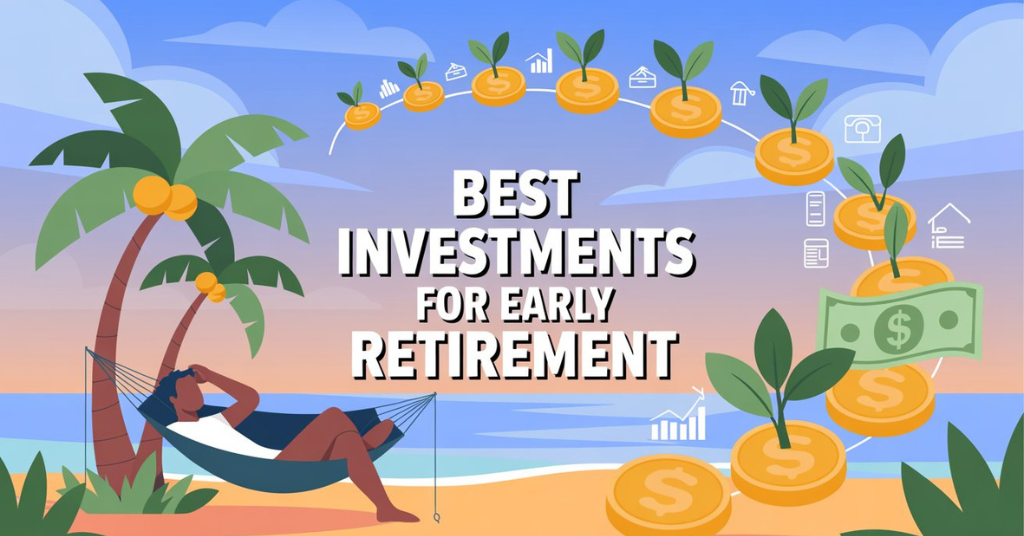
Early retirement is a dream for many people. Instead of working until the age of 60 or 65, some people want to retire in their 40s or 50s and enjoy life earlier. To achieve this goal, you need strong financial planning and smart investments.
The idea of early retirement is closely related to the Financial Independence, Retire Early (FIRE) strategy, where people save a large part of their income and invest it to build wealth faster.
In simple words, early retirement means having enough investments that generate income even when you stop working.
In this blog, you will learn:
- How much money you need for early retirement
- The best investments for early retirement
- Examples with dollar calculations
- Simple strategies to build wealth faster
Let’s understand everything step-by-step.
What Is Early Retirement?
Early retirement means leaving your full-time job earlier than the traditional retirement age.
Instead of depending on a salary, your investments generate income that covers your living expenses.
Most early retirement plans use the Rule of 25 and the 4% rule.
The Rule of 25
According to this rule, you should save 25 times your yearly expenses before retiring.
Example
Suppose your yearly expenses are:
- Housing: $12,000
- Food: $6,000
- Transportation: $4,000
- Other expenses: $8,000
Total yearly expenses = $30,000
Required retirement savings:
$30,000 × 25 = $750,000
So, if you have $750,000 invested, you may be able to retire early.
Understanding the 4% Rule
The 4% rule suggests that retirees can withdraw about 4% of their investments each year without running out of money for decades.
Example
If you have:
Total investment = $1,000,000
Yearly withdrawal:
$1,000,000 × 4% = $40,000 per year
Monthly income:
$40,000 ÷ 12 = $3,333 per month
This amount can support your living expenses in retirement.
Why Investing Is Important for Early Retirement
Saving money alone is not enough for early retirement.
Investments help your money grow through compound interest and long-term growth.
Benefits of investing:
- Wealth grows faster than regular savings
- Passive income is created
- Money beats inflation
- Financial independence becomes possible
For example:
If you save $500 per month without investing, you will have:
$500 × 12 × 30 years = $180,000
But if you invest the same amount with 8% annual return, you could have more than $740,000 after 30 years.
That is the power of investing.
Best Investments for Early Retirement
Now let’s explore the best investment options that can help you retire early.
1. Stock Market Investments
Stocks are one of the best investments for long-term wealth building.
When you buy shares of companies, you become a part owner of the business.
Over time, stocks grow in value and may also pay dividends.
Benefits of Stocks
- High long-term returns
- Capital growth
- Dividend income
Example
Suppose you invest $10,000 in stocks with an average return of 10% per year.
After 20 years:
Future value = $10,000 × (1.10)²⁰
Future value ≈ $67,275
Your money grows more than six times.
This is why stocks are a key investment for early retirement.
2. Index Funds and ETFs
Index funds are investment funds that track a market index like the S&P 500.
They are popular because:
- They have low fees
- They are diversified
- They are easy to manage
Experts often recommend low-cost index funds for long-term investors.
Example
If you invest $300 every month in an index fund with an average return of 8%, your investment may grow like this:
After 20 years:
Total investment = $300 × 12 × 20
= $72,000
Estimated value with returns = $177,000+
This shows how consistent investing builds wealth.
3. Real Estate Investments
Real estate is another powerful investment for early retirement.
You can earn money from:
- Rental income
- Property value appreciation
Example
Suppose you buy a rental property for $200,000.
Monthly rent = $1,500
Yearly rental income:
$1,500 × 12 = $18,000
If yearly expenses are $6,000, your profit becomes:
$18,000 − $6,000 = $12,000 per year
This passive income can support your retirement lifestyle.
4. Dividend Stocks
Dividend stocks are shares of companies that pay regular profits to investors.
These payments are called dividends.
Dividend stocks are great for early retirement because they provide regular income.
Example
Suppose you build a $800,000 dividend portfolio with an average 4% dividend yield.
Yearly dividend income:
$800,000 × 4% = $32,000
Monthly income:
$32,000 ÷ 12 ≈ $2,666
This income can cover a large portion of living expenses.
5. Bonds and Fixed Income Investments
Bonds are safer investments compared to stocks.
They provide regular interest payments.
Many investors include bonds in their portfolio to reduce risk.
Example Portfolio Allocation
| Investment | Percentage |
| Stocks | 60% |
| Bonds | 20% |
| Real Estate | 10% |
| Cash | 10% |
Diversification like this helps balance risk and growth.
6. Passive Income Investments
Passive income is income that you earn without active work.
Examples include:
- Rental income
- Dividends
- Online businesses
- Royalties
Passive income helps you maintain financial independence after retirement.
Example
Suppose you have three passive income sources:
Rental income = $12,000
Dividends = $18,000
Online business = $10,000
Total passive income:
$12,000 + $18,000 + $10,000 = $40,000 per year
If your yearly expenses are $35,000, you can easily retire early.
How Much Should You Invest Every Month?
Let’s see a simple early retirement example.
Goal: $1,000,000 retirement fund
Investment return: 8% per year
Time: 25 years
Monthly investment needed ≈ $1,100
Calculation summary:
$1,100 × 12 × 25 = $330,000 invested
Final value after growth ≈ $1,000,000
This shows how consistent investing and compound interest create wealth.
Tips to Reach Early Retirement Faster
Here are some practical tips to reach early retirement.
1. Increase Your Savings Rate
Try to save 30–50% of your income if possible.
2. Avoid High Investment Fees
High fees can reduce your investment returns significantly.
3. Invest Regularly
Invest money every month instead of waiting for the perfect time.
4. Diversify Your Investments
Do not invest all your money in one asset.
5. Control Lifestyle Inflation
When your income increases, avoid increasing expenses too much.
Common Risks in Early Retirement
Early retirement also comes with some risks.
Market Risk
Stock markets can fall temporarily.
Inflation
Living costs increase over time.
Healthcare Costs
Medical expenses may rise in the future.
Longevity Risk
You may live longer than expected.
Planning your investments carefully helps reduce these risks.
Also Read: Should Retirees Invest in Gold? An Advisor Guide
Final Thoughts
Early retirement is possible if you start investing early and remain disciplined.
The most effective investments for early retirement include:
- Stocks
- Index funds
- Real estate
- Dividend stocks
- Bonds
- Passive income assets
By saving consistently, investing wisely, and controlling expenses, you can build a portfolio that generates enough income to support your lifestyle.
Remember, early retirement is not about luck. It is about smart planning, patience, and consistent investing.
If you start today, your future self will thank you.