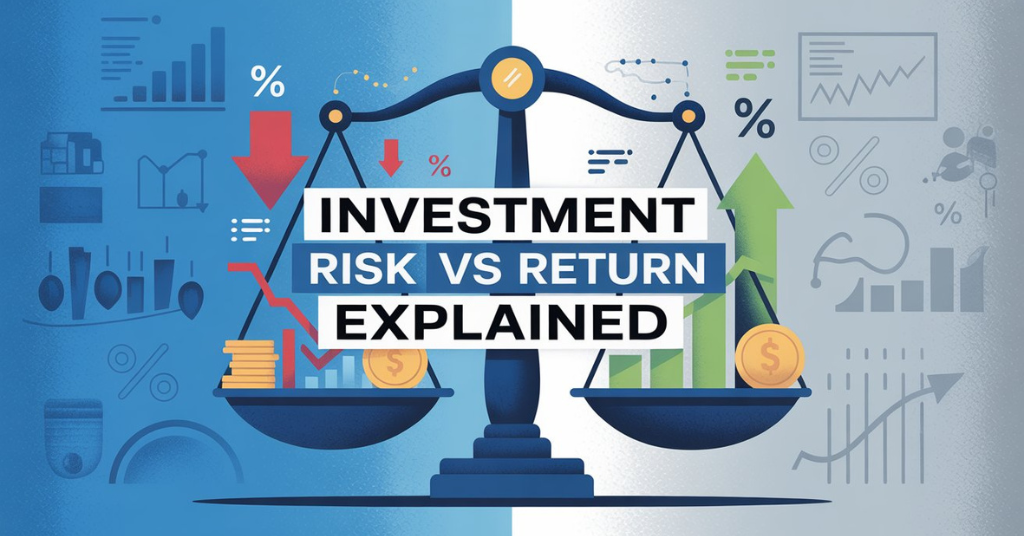
Investment is one of the best ways to grow money over time. However, many people feel confused or scared because of one important concept: risk. At the same time, everyone wants a good return on their money. This is where the idea of investment risk vs return comes in.
In very simple words, risk and return are connected. If you want higher returns, you usually need to take higher risk. If you want safety, you often have to accept lower returns. Understanding this balance helps you make smarter financial decisions and avoid costly mistakes.
In this blog, we have investment risk vs return explained in a very easy and clear way. You will also see real-life examples, simple calculations in dollars, and practical tips that anyone can understand.
What Is Investment Risk?
Investment risk means the chance that you may not get the return you expect or may even lose part of your money.
Risk does not always mean loss. It simply means uncertainty. The value of your investment may go up, go down, or stay the same.
Simple Example of Risk
If you invest $1,000 in a company:
- The value may grow to $1,300 (profit)
- It may fall to $700 (loss)
- Or it may remain near $1,000
This uncertainty is called investment risk.
What Is Investment Return?
Return is the money you earn from an investment. It includes:
- Interest
- Dividends
- Increase in value (capital gain)
Returns are usually shown as a percentage.
Simple Return Formula

Example
If you invest $1,000 and it becomes $1,200 after one year:
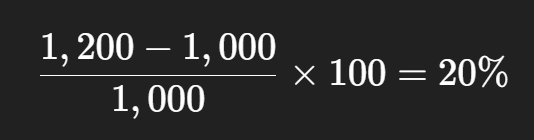
So, your return is 20%.
Understanding the Risk vs Return Relationship
The risk vs return relationship means:
- Higher risk → possibility of higher return
- Lower risk → lower but more stable return
There is no guarantee that higher risk will always give higher returns. It only increases the possibility.
Why This Relationship Exists
Investors expect a reward for taking extra risk. If two investments offer the same return, people usually choose the one with lower risk.
Low-Risk Investments and Returns
Low-risk investments are safer and more stable, but their returns are usually smaller.
Examples of Low-Risk Investments
- Savings accounts
- Fixed deposits
- Government bonds
Example with Calculation
You invest $5,000 in a low-risk bond paying 4% per year.
5,000×4%=200
After one year:
- Return = $200
- Total value = $5,200
This is safe but slow growth.
Medium-Risk Investments and Returns
Medium-risk investments balance safety and growth.
Examples
- Corporate bonds
- Balanced mutual funds
- Index funds
Example
You invest $5,000 in a balanced fund earning 8% per year.
5,000×8%=400
After one year:
- Return = $400
- Total value = $5,400
Risk is higher than a bond, but returns are also better.
High-Risk Investments and Returns
High-risk investments can grow fast but can also lose value quickly.
Examples
- Stocks
- Crypto assets
- Startup investments
Example
You invest $5,000 in stocks.
Scenario 1: Market goes up
- Value increases by 25%
5,000×25%=1,250
Total value = $6,250
Scenario 2: Market goes down
- Value drops by 20%
5,000×20%=1,000
Total value = $4,000
This shows how high risk can lead to both high gains and big losses.
Types of Investment Risk (In Simple Words)
1. Market Risk
The risk of losing money due to overall market movements.
2. Inflation Risk
When your return is lower than inflation, your money loses buying power.
Example
If inflation is 5% and your investment returns 3%, you are losing 2% in real value.
3. Credit Risk
The risk that a borrower may not pay back the money.
4. Liquidity Risk
The risk that you cannot sell your investment quickly without losing value.
How Risk Is Measured (Simple Explanation)
Standard Deviation
It shows how much returns move up and down.
- High deviation = high risk
- Low deviation = low risk
Beta
It compares an investment’s movement with the market.
- Beta above 1 → more risky than the market
- Beta below 1 → less risky than the market
What Is Risk-Adjusted Return?
Risk-adjusted return shows how much return you earn for the risk taken.
Two investments may give the same return, but one may be riskier.
Example
- Investment A: 10% return with high ups and downs
- Investment B: 8% return with stable movement
Many investors prefer Investment B because it gives better peace of mind.
Risk vs Return in a Portfolio
A portfolio is a group of investments.
Why Portfolios Matter
You don’t invest all money in one place. Mixing assets helps reduce risk.
Example Portfolio
| Investment Type | Amount |
| Bonds | $4,000 |
| Stocks | $4,000 |
| Cash | $2,000 |
Total = $10,000
This mix balances risk and return.
How Diversification Reduces Risk
Diversification means spreading money across different assets.
Example Without Diversification
- All $10,000 in one stock
- Stock falls 30%
- Loss = $3,000
Example With Diversification
- $5,000 in stocks
- $5,000 in bonds
- Stock falls 30% → Loss = $1,500
- Bonds remain stable
Loss is much smaller.
Time Horizon and Risk vs Return
Short-Term Investors
- Need money soon
- Prefer low risk
- Accept lower returns
Long-Term Investors
- Have more time
- Can handle ups and downs
- Can aim for higher returns
Example
If you invest $3,000 at 10% per year:
- 1 year → $3,300
- 10 years → around $7,781
Time reduces risk impact and increases growth.
Common Myths About Risk and Return
Myth 1: High Risk Always Gives High Return
Reality: High risk increases chance, not guarantee.
Myth 2: Low Risk Means No Risk
Reality: Inflation and interest rate changes still affect low-risk investments.
Myth 3: Avoiding Risk Is Best
Reality: Avoiding all risk may stop your money from growing.
How to Choose the Right Risk Level
Ask yourself:
- How much loss can I emotionally handle?
- How long can I stay invested?
- What is my financial goal?
Simple Rule
- Young investors → higher risk allowed
- Near retirement → lower risk preferred
Smart Tips to Manage Risk and Improve Returns
- Start early
- Diversify investments
- Avoid emotional decisions
- Review portfolio regularly
- Match investments with goals
Real-Life Combined Example
You invest $20,000 as follows:
- $8,000 in bonds at 4%
- $8,000 in stocks at 12%
- $4,000 in cash
Annual Returns
- Bonds: $320
- Stocks: $960
- Cash: $0
Total Return = $1,280
Overall return = 6.4%
This is a balanced approach to risk and return.
Also Read: Index Funds vs Stocks Explained Simply
Final Conclusion: Investment Risk vs Return Explained
Investment risk vs return is about finding the right balance between safety and growth. Higher returns usually require higher risk, while lower risk offers stability but slower growth. Understanding this relationship helps you make smarter investment decisions, protect your money, and grow wealth over time.
By using diversification, knowing your risk tolerance, and thinking long term, you can manage risk wisely and enjoy better returns without unnecessary stress.