When we start investing, one big fear is:
“What if I lose all my money?”
This is where diversification comes in.
Diversification is a way of investing that protects your money by spreading it across different investments. Instead of putting all your money into one place, you divide it into many parts. This helps reduce risk and makes your investment journey smoother.
In this blog, we will understand:
- What is diversification in investing
- Why diversification is important
- Types of diversification
- Simple examples and calculations
- Benefits and limitations of diversification
- How you can start diversifying your own portfolio
The language will be very simple, so even a beginner can understand everything clearly.
What Is Diversification In Investing?
Diversification in investing means spreading your money across different types of investments so that your total risk becomes lower.
Instead of keeping all your money in:
- Only one stock
- Only one sector
- Only one country
you divide it into:
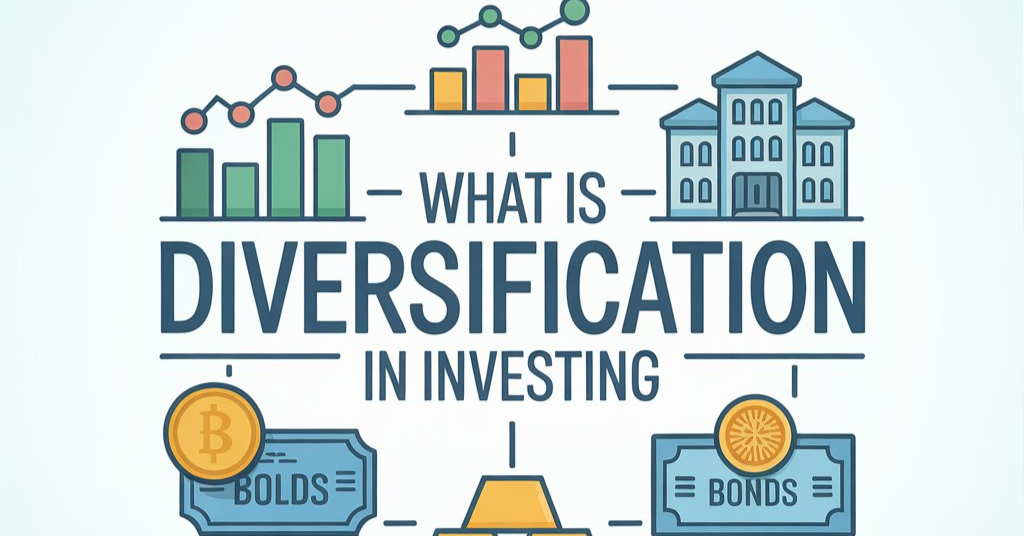
- Different asset classes (like stocks, bonds, gold, cash, etc.)
- Different sectors (like technology, banking, healthcare, energy, etc.)
- Different countries or regions
The simple idea is:
“Don’t put all your eggs in one basket.”
If one basket falls, you won’t lose all your eggs.
In the same way, if one investment performs badly, your other investments may do better and help balance the total result.
Why Is Diversification Important?
Diversification is important because it helps you:
- Reduce Risk
If you invest only in one company and that company fails, you may lose a big part of your money. But if your money is spread over 20–30 different investments, the failure of one or two will not destroy your entire portfolio. - Smooth Returns Over Time
Markets go up and down. Some assets may fall while others may rise. When your portfolio is diversified, these ups and downs get balanced. This makes your returns more stable in the long run. - Avoid Emotional Decisions
If one investment is falling, you may panic and sell it at a loss. In a diversified portfolio, the fall in one part is often balanced by gains in another. This helps you stay calm and think long term. - Improve Chances Of Better Long-Term Results
Diversification does not guarantee profit, but it helps protect you from large losses and gives a better chance of steady growth over many years.
Types Of Diversification
There are different ways to diversify your investments. Let’s understand each in simple language.
1. Diversification Across Asset Classes
Asset classes are different types of investments, such as:
- Stocks (Equity) – Ownership in companies
- Bonds (Debt) – Loans to companies or governments
- Real Estate – Property or land
- Gold/Commodities – Physical assets like gold, silver, oil, etc.
- Cash or Cash Equivalents – Savings, fixed deposits, etc.
By investing in a mix of these, you reduce your risk. For example:
- When stock markets crash, bonds may perform better.
- When currency is weak, gold may act as a safe asset.
So, if you put some money in each asset class, your total portfolio becomes more stable.
2. Diversification Within Asset Classes (e.g., Within Stocks)
Even inside one asset class, you can diversify.
For example, in stocks, you can diversify by:
- Sectors – technology, banking, FMCG, healthcare, energy, etc.
- Company Size – large-cap, mid-cap, small-cap
- Style – growth stocks, value stocks, dividend stocks
If you buy only technology stocks and that sector faces a problem, your entire portfolio will fall. But if you also hold banking, pharma, and FMCG stocks, the impact will be lower.
3. Geographical Diversification
You can also diversify by countries or regions, such as:
- Domestic (your home country)
- International (other countries)
Sometimes, one country’s economy may be slow, while another country may be growing. By investing in both, you reduce the risk of being dependent on only one economy.
4. Time Diversification (Investing Over Time)
Another form of diversification is not investing all your money at once, but investing regularly over time.
For example:
- Using SIPs (Systematic Investment Plans) in mutual funds
- Investing a fixed amount every month
This helps average out the price. Sometimes you buy when the market is high, sometimes when it is low. Over time, your average cost becomes moderate.
A Simple Example Of Diversification (With Numbers)
Let’s understand diversification using a very simple example with numbers.
Case 1: No Diversification (All Money In One Stock)
Suppose you have $10,000 to invest.
You decide to invest everything in Company A.
- After one year, due to bad news, Company A’s stock value falls by 50%.
- Your investment becomes:
$10,000×(1−0.50)=$5,000
You lost $5,000, which is 50% of your entire money because you had no diversification.
Case 2: Diversified Across 4 Different Investments
Now, imagine you invest your $10,000 in four different assets:
- $2,500 in Company A (stock)
- $2,500 in Company B (stock)
- $2,500 in a bond fund
- $2,500 in gold
Now, after one year:
- Company A falls by 50%
- Company B rises by 20%
- Bond fund gives 5% return
- Gold rises by 10%
Let’s calculate each:
- Company A:
$2,500×(1−0.50)=$1,250 - Company B:
$2,500×(1+0.20)=$3,000 - Bond Fund:
$2,500×(1+0.05)=$2,625 - Gold:
$2,500×(1+0.10)=$2,750
Now total portfolio value:
$1,250+$3,000+$2,625+$2,750=$9,625
So, instead of falling to $5,000 like in Case 1, your diversified portfolio is $9,625.
Yes, you still lost $375 from your original $10,000, but the loss is only 3.75%, not 50%.
This is the power of diversification.
It cannot fully remove loss, but it reduces the size of loss.
Another Example: Sector Diversification
Suppose you invest $6,000 only in airline stocks.
If the airline industry suffers due to high fuel prices or travel bans, many airline companies can fall together.
But if instead you do this:
- $2,000 in airline stocks
- $2,000 in healthcare stocks
- $2,000 in technology stocks
Then even if airlines fall badly, healthcare and technology may do better and help protect your total money.
What Diversification Can And Cannot Do
It is very important to understand both benefits and limitations of diversification.
What Diversification Can Do
- Reduce Specific Risk
It mainly reduces company-specific and sector-specific risk. If one company or one sector performs badly, others can balance it out. - Smooth Portfolio Volatility
Different assets move differently. Some may rise when others fall. This creates smoother, less volatile returns. - Protect From Big Losses
You are less likely to lose a very large portion of your money at once if your portfolio is properly diversified.
What Diversification Cannot Do
- Cannot Remove Market Risk Completely
If the whole market crashes (for example, in a big global crisis), most assets may fall together. In such cases, even a diversified portfolio can lose value, but usually less than a non-diversified one. - Cannot Guarantee Profit
Diversification reduces risk; it does not guarantee profit. You can still have negative returns in bad years. - Cannot Fully Protect Against Emotional Mistakes
If you panic and sell everything at the lowest point, even the best diversified portfolio cannot protect you from yourself. Discipline and patience are also important.
How Many Investments Do You Need To Be Diversified?
There is no fixed number, but generally:
- Holding just 2–3 stocks is not enough.
- A portfolio with 15–30 different stocks across various sectors is usually more diversified.
- Adding other asset classes like bonds, gold, and cash gives even better diversification.
Remember, diversification is about variety, not just number.
You should choose investments that do not move in the same way all the time.
Simple Asset Allocation Example
Here is a very basic example of diversification for a moderate-risk investor with $20,000:
- 50% in stocks: $10,000
- 30% in bonds: $6,000
- 10% in gold: $2,000
- 10% in cash / savings: $2,000
This way:
- Stocks give growth in the long term
- Bonds give stable income
- Gold protects against inflation and currency risk
- Cash gives liquidity for emergencies
You can change the percentages based on your age, risk level, and goals.
How To Start Diversifying Your Portfolio
If you are a beginner, here are some simple steps:
1. Understand Your Risk Profile
Ask yourself:
- How much loss can I tolerate?
- For how many years can I stay invested?
- Do I need this money soon (for education, marriage, house, etc.)?
If you are young and can stay invested for many years, you can keep a larger part in stocks.
If you are closer to retirement, you may keep more in bonds and safer assets.
2. Use Mutual Funds Or ETFs
If picking individual stocks is difficult, you can use:
- Mutual funds
- Exchange Traded Funds (ETFs)
These funds already hold many securities inside, so by buying just one fund, you are automatically getting diversification.
For example:
- A stock index fund may hold 50–100 or more companies.
- A bond fund may hold many different bonds.
This is an easy way for small investors to get diversification without buying many different stocks directly.
3. Mix Different Types Of Funds
You can create a diversified portfolio using a mix of:
- Equity mutual funds or ETFs
- Debt or bond funds
- Gold funds or gold ETFs
- International funds (optional, if available)
Example for a balanced investor:
- 50% in equity index fund
- 30% in bond fund
- 10% in gold fund
- 10% in cash or short-term debt fund
4. Invest Regularly
Instead of putting all your money at one time, you can:
- Invest monthly using SIPs
- Invest whenever you have extra savings
This gives you time diversification, reduces the impact of wrong timing, and makes investing a habit.
5. Review And Rebalance
Over time, some investments will grow faster than others.
For example, suppose your original plan was:
- 60% in stocks
- 30% in bonds
- 10% in gold
After a few years, due to stock market growth, your portfolio becomes:
- 75% in stocks
- 20% in bonds
- 5% in gold
This is now more risky than your original plan.
So you can rebalance by:
- Selling some stocks
- Buying more bonds and gold
to bring it back to 60-30-10. This keeps your risk level under control.
Common Mistakes To Avoid
While diversifying, try to avoid these common mistakes:
- Over-Diversification
Holding 100+ different investments can become hard to track and may not give much extra benefit beyond a certain point. - Investing Only In One Country Or Sector
Even if you have many stocks, if all are from one sector or country, your diversification is still weak. - Chasing Past Performance
Don’t buy only what has performed best recently. Good diversification means mixing fast-growing assets with stable ones. - Ignoring Costs
Check expense ratios, brokerage fees, and other charges. Too many high-cost products can eat away your returns.
Also Read: How to Use Equity to Buy Investment Property: Step-by-Step Guide
Conclusion: Diversification Is Your Safety Shield
So, what is diversification in investing?
It is a smart risk-management method where you spread your money across different:
- Asset classes (stocks, bonds, gold, cash, etc.)
- Sectors (technology, banking, healthcare, etc.)
- Regions (domestic and international)
- Time (investing regularly instead of all at once)
Diversification reduces the impact of any one investment performing badly. It helps you:
- Lower your risk
- Avoid big losses
- Get smoother and more stable returns in the long term
Remember, diversification does not guarantee profits and cannot fully remove market risk, but it acts like a safety shield for your money.
If you are a beginner investor, start with:
- A simple mix of equity, debt, gold, and cash
- Regular investments (like monthly SIPs)
- Periodic review and rebalancing
Over time, this disciplined and diversified approach can help you grow your wealth more safely and confidently.