Retirement planning is one of the most important financial decisions in life. Many traditional retirement portfolios include bonds because they provide stable income and lower risk compared to stocks. However, some investors want alternatives to bonds due to low interest rates, inflation concerns, or the desire for higher returns.
Fortunately, there are several investments that can generate steady income in retirement without relying on bonds. These investments can help retirees maintain cash flow, grow wealth, and protect purchasing power.
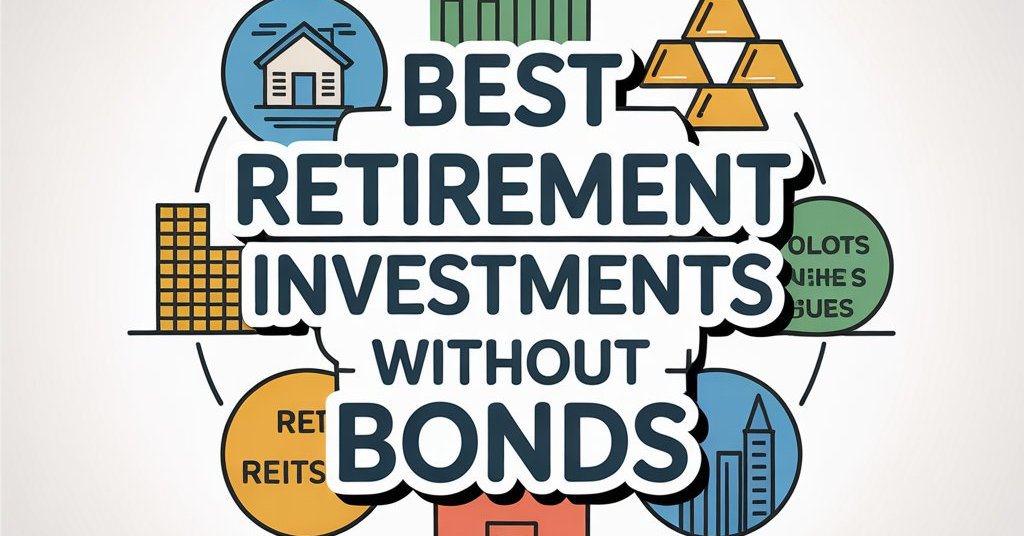
In this guide, we will explore the best retirement investments without bonds, their benefits, risks, and examples to help you understand how they can fit into a retirement portfolio.
Why Some Retirees Avoid Bonds
Before exploring alternatives, it is important to understand why some investors avoid bonds.
Common reasons include:
1. Low Returns
Historically, bonds have generated moderate returns. Long-term bond markets have delivered roughly 4–6% average annual returns, which may not keep up with inflation in some periods.
2. Inflation Risk
If inflation rises faster than bond interest rates, the purchasing power of income decreases.
Example:
| Investment | Return | Inflation | Real Return |
| Bond | 5% | 6% | -1% |
In this case, the investor actually loses purchasing power.
3. Interest Rate Risk
When interest rates rise, existing bond prices usually fall.
Because of these factors, many retirees look for income investments other than bonds.
Key Goals of Retirement Investments
Before choosing alternatives, every retirement portfolio should aim for three goals:
- Regular income
- Capital preservation
- Inflation protection
A balanced portfolio without bonds can still achieve these goals by using multiple investment types.
Best Retirement Investments Without Bonds
1. Dividend Stocks
Dividend stocks are shares of companies that regularly distribute part of their profits to shareholders.
These stocks are popular for retirement because they provide passive income while still offering growth potential.
Example
Suppose you invest $200,000 in dividend stocks with a 4% annual yield.
Calculation:
Annual Income = Investment × Dividend Yield
= $200,000 × 4%
= $8,000 per year
This income can support retirement expenses while the stock value may continue growing.
Benefits
- Regular income
- Potential capital appreciation
- Dividend increases over time
Risks
- Stock price volatility
- Dividends may be reduced during economic downturns
2. Real Estate Investments
Real estate is one of the most popular income-generating retirement investments.
Retirees can invest in:
- Rental properties
- Real estate funds
- Real estate investment trusts (REITs)
Rental properties typically generate 4–6% rental yield annually, depending on location and property type.
Example
If a property costs $300,000 and produces 5% rental yield:
Annual rental income =
$300,000 × 5%
= $15,000 per year
Benefits
- Stable cash flow
- Inflation protection
- Tangible asset ownership
Risks
- Property maintenance costs
- Tenant vacancies
- Low liquidity
3. Real Estate Investment Trusts (REITs)
REITs allow investors to earn real estate income without owning property directly.
REITs own income-producing properties like:
- Shopping malls
- Office buildings
- Apartments
- Warehouses
They typically distribute most of their profits as dividends, making them attractive for retirees.
Example
Investment = $100,000
REIT dividend yield = 6%
Annual income = $100,000 × 6%
= $6,000
Benefits
- High dividend income
- Liquidity (traded on stock exchanges)
- Diversified real estate exposure
Risks
- Sensitive to interest rates
- Real estate market cycles
4. Annuities
Annuities are insurance products designed to provide guaranteed income during retirement.
Investors deposit a lump sum and receive regular payments monthly or yearly. Some annuities provide income for life, helping retirees manage longevity risk.
Example
If you invest $250,000 in an annuity paying 5% annually:
Annual income = $250,000 × 5%
= $12,500 per year
Benefits
- Predictable income
- Protection against outliving savings
- Low market risk
Risks
- Limited liquidity
- Potential fees
5. Dividend ETFs
Dividend ETFs invest in multiple dividend-paying companies, providing diversification.
Instead of buying individual stocks, retirees can invest in a single ETF that holds many companies.
Example
Investment = $150,000
Dividend ETF yield = 3.5%
Annual income = $150,000 × 3.5%
= $5,250
Benefits
- Diversified income
- Lower risk compared to single stocks
- Passive investment
Risks
- Market fluctuations
- Dividend variability
6. Alternative Investments
Alternative assets include investments outside traditional stocks and bonds.
Examples include:
- Commodities
- Precious metals
- Infrastructure funds
- Private equity
- Venture capital
These assets can diversify retirement portfolios because they do not always move with stock markets.
However, some alternative investments require large minimum investments and may have high fees or low liquidity.
7. High-Yield Savings and Cash Investments
Although they may not generate large returns, cash investments provide stability.
Examples include:
- High-yield savings accounts
- Certificates of deposit
- Money market funds
These options provide safe liquidity for short-term retirement expenses.
Example of a Retirement Portfolio Without Bonds
A retiree with $500,000 savings could build a diversified portfolio like this:
| Investment | Allocation | Expected Yield | Annual Income |
| Dividend Stocks | $200,000 | 4% | $8,000 |
| REITs | $100,000 | 6% | $6,000 |
| Real Estate | $100,000 | 5% | $5,000 |
| Dividend ETF | $50,000 | 3.5% | $1,750 |
| Cash Investments | $50,000 | 2% | $1,000 |
Total Annual Income
= $21,750 per year
This portfolio produces income without investing in bonds.
Tips for Building a Bond-Free Retirement Portfolio
1. Diversify Income Sources
Do not rely on a single investment.
2. Focus on Cash Flow
Choose investments that generate consistent income.
3. Manage Risk
Balance growth investments with stable income assets.
4. Plan for Inflation
Invest in assets that can increase income over time.
5. Maintain Liquidity
Always keep emergency funds accessible.
Also Read: Best Global Dividend Funds for Seniors
Pros and Cons of Retirement Investments Without Bonds
Advantages
- Higher potential returns
- Better inflation protection
- Multiple income sources
- Portfolio diversification
Disadvantages
- Higher market risk
- Income variability
- Some investments require active management
Final Thoughts
Bonds have long been a traditional part of retirement portfolios, but they are not the only option for generating retirement income. Investments such as dividend stocks, REITs, real estate, annuities, and dividend ETFs can provide steady cash flow while offering growth potential.
The key to successful retirement planning without bonds is diversification and careful risk management. By combining different income-producing assets, retirees can build a stable portfolio that supports long-term financial security.