Retirement is a time when people want financial security, stable income, and peace of mind. After decades of saving and investing, retirees depend on their savings to pay for living expenses, healthcare, travel, and emergencies.
Because of this, making the wrong investment decision during retirement can be very risky. Some investments may look attractive, but they can cause high losses, high fees, or limited access to money.
Financial experts often say that retirees should focus on capital protection, steady income, and low risk rather than chasing high returns. Some investment options may work well for younger investors but are not suitable for retirees.
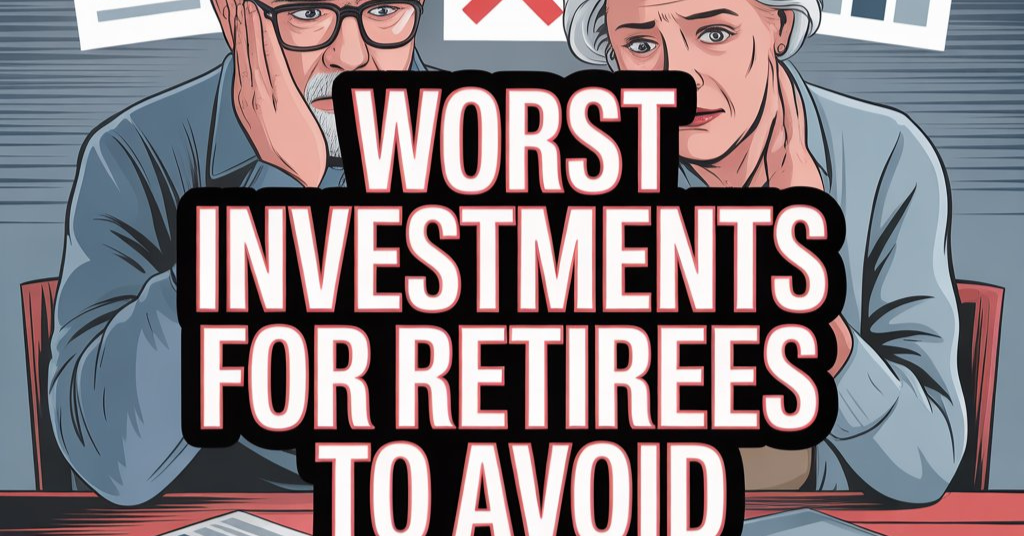
In this guide, we will explain the worst investments for retirees to avoid, along with simple examples and dollar calculations.
Worst Investments for Retirees to Avoid
1. High-Risk Speculative Stocks
Speculative stocks include:
- Penny stocks
- Small unknown companies
- Highly volatile tech startups
These stocks can rise quickly, but they can also fall dramatically.
Experts often warn retirees to avoid high-risk speculative investments, because losses can happen quickly and there may not be enough time to recover before retirement funds are needed.
Example
Suppose a retiree invests:
- $40,000 in speculative stocks
If the market falls 50%, the investment becomes:
$40,000 × 50% = $20,000 loss
Remaining value:
$40,000 − $20,000 = $20,000
Recovering from such losses during retirement can be extremely difficult.
2. Leveraged ETFs
Leveraged ETFs are investment funds that try to multiply market returns.
For example:
- 2× ETF → doubles market gains or losses
- 3× ETF → triples market gains or losses
These investments are very risky for retirees because market losses become much larger.
Example
Imagine a retiree invests $50,000 in a 3× leveraged ETF.
If the market falls 10%, the ETF may drop 30%.
Loss calculation:
$50,000 × 30% = $15,000 loss
Remaining value:
$50,000 − $15,000 = $35,000
Large losses like this can reduce retirement savings very quickly.
3. High-Fee Mutual Funds
Many mutual funds charge high management fees every year. Some funds charge more than 1% annually, which can reduce long-term returns.
At first the fee may seem small, but over time it can cost thousands of dollars.
Example
Suppose a retiree invests:
- $200,000 in a fund with 1.5% annual fee
Annual fee cost:
$200,000 × 1.5% = $3,000 per year
If the investment is held for 20 years, total fees paid:
$3,000 × 20 = $60,000
That means $60,000 of retirement savings goes only toward fees.
4. Alternative Investments (Private Equity and Hedge Funds)
Alternative investments include:
- Private equity
- Hedge funds
- Venture capital
- Private credit funds
These investments often charge extremely high fees, such as 2% management fees plus 20% of profits.
They may also lock money for long periods and require large minimum investments.
Example
Suppose someone invests $300,000 in a hedge fund.
Annual management fee (2%):
$300,000 × 2% = $6,000 per year
If the fund earns 10% profit ($30,000):
Performance fee (20%):
$30,000 × 20% = $6,000
Total fees in one year:
$6,000 + $6,000 = $12,000
So even with good returns, large fees reduce the investor’s profit.
5. Too Much Real Estate
Many retirees believe real estate is the safest investment, but relying too heavily on property can be risky.
Real estate has several problems:
- Low liquidity
- Maintenance costs
- Uncertain rental income
- High transaction costs
Selling property can take months and may require accepting a lower price if money is needed quickly.
Example
A retiree buys a rental property worth:
$400,000
Annual rent received:
$12,000
Rental yield:
$12,000 ÷ $400,000 = 3% return
Now subtract expenses:
- Maintenance = $3,000
- Property tax = $2,000
- Repairs = $1,000
Total expenses = $6,000
Actual income:
$12,000 − $6,000 = $6,000
Real return:
$6,000 ÷ $400,000 = 1.5%
This is a very low return for such a large investment.
6. Locking All Money in Annuities
Annuities promise guaranteed income, but they also have disadvantages.
Many annuities offer returns around 5%–6%, which may not keep up with inflation.
Another problem is that once money is invested in an annuity, it is often locked for many years.
Example
Suppose a retiree invests:
$250,000 in an annuity paying 5% per year
Annual income:
$250,000 × 5% = $12,500
If inflation rises to 6%, purchasing power decreases.
Real return:
5% − 6% = −1%
This means the retiree is slowly losing purchasing power every year.
7. Keeping Too Much Money in Cash
Many retirees believe cash is the safest option. While cash protects against market volatility, keeping too much money in cash can reduce long-term wealth.
Research shows many retirees hold nearly half of their assets in cash, which can increase the risk of running out of money later due to inflation.
Example
Suppose a retiree keeps:
$300,000 in cash
If inflation averages 5% per year, the real value after 10 years becomes:
Future purchasing value calculation:
$300,000 ÷ (1.05¹⁰)
$300,000 ÷ 1.63 ≈ $184,000
This means the purchasing power drops by more than $100,000.
8. Investments That Lock Money for Many Years
Some investments prevent investors from withdrawing money easily.
Examples include:
- Private investment funds
- Some real estate funds
- Long-term structured products
Some private investments may lock money for 5–10 years, making them unsuitable for retirees who may need quick access to funds.
Key Signs of Bad Retirement Investments
Here are common warning signs that an investment may not be suitable for retirees.
| Warning Sign | Why It Is Dangerous |
| High volatility | Large losses may occur quickly |
| High management fees | Reduces long-term returns |
| Illiquid assets | Hard to access money |
| Complex structure | Difficult to understand risk |
| Low inflation protection | Purchasing power decreases |
Better Investment Approach for Retirees
Instead of risky investments, retirees should focus on balanced and diversified portfolios.
A simple retirement strategy may include:
- Dividend-paying stocks
- Bonds or bond funds
- Low-cost index funds
- Cash for emergencies
- Inflation-protected securities
Diversification helps reduce risk and provides stable income over time.
Also Read: Best Gold ETFs for Retirees – A Complete Guide
Conclusion
Retirement investing is very different from investing during working years. At this stage, the main goal is protecting savings and generating steady income.
Investments such as speculative stocks, leveraged ETFs, high-fee funds, alternative investments, excessive real estate, and large cash holdings can create serious financial risks for retirees.
Before making any investment decision, retirees should focus on liquidity, low fees, diversification, and inflation protection. A well-balanced portfolio can help ensure that retirement savings last for many years and provide financial peace of mind.